Home›Spears
Keg spears and spare parts
Complete overhaul and seal replacement in our own works, spears from well-known manufacturers, new AOBAOSI spears from the EU warehouse. One contact for every type.
Aobaosi spears from the EU warehouse in Miastko

Manufacturer · Zhejiang

EU warehouse · Miastko
- Available from stockFrom the Miastko stock, with no wait for sea freight.
- Straight from the manufacturerWe are the European distributor – no middleman.
- Series production, 2″ × 14 TPIAll five types to the manufacturer’s drawing, dimensions documented.
| Type | Designation | Body Ø | Distribution |
|---|---|---|---|
| A | Flat spear (A-type) | 74.5 mm | Germany, Austria, large parts of Europe – the most common type |
| S | EU Sankey spear (S-type) | 50.8 mm | Belgium, the Netherlands, parts of France – no housing above the neck: the body sits inside the neck and is screwed in with the standard thread. Its largest diameter is therefore the outside diameter of that thread, 2″ × 14 TPI, i.e. 50.8 mm |
| D | US Sankey (D-type) | 53.7 / 50.2 mm | no body above the neck – sits inside, held by a thread or by locking lugs |
| G | Triangular spear (G-type) | 70 mm | internally identical to type A – three-lobed flange instead of a round body |
| M | Combi spear (M-type) | 74.5 mm | Poland, Czechia, parts of Germany – bayonet and thread in one head |
| L | Soft-drink spear | 56 / 58 / 60 mm | soft drinks and wine, up to 7 bar – three designs, see below |
Tools that fit here
Riser length and weight · Identify your keg · Tap head finder
Before shortening a riser, when identifying the keg type and when asking which tap head fits.
The view from above
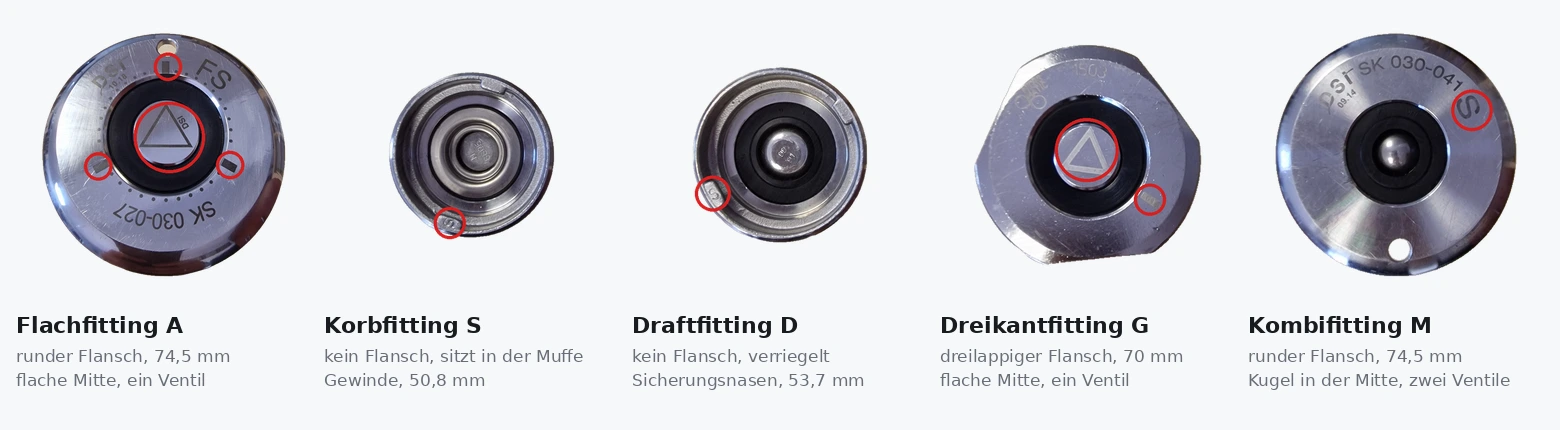
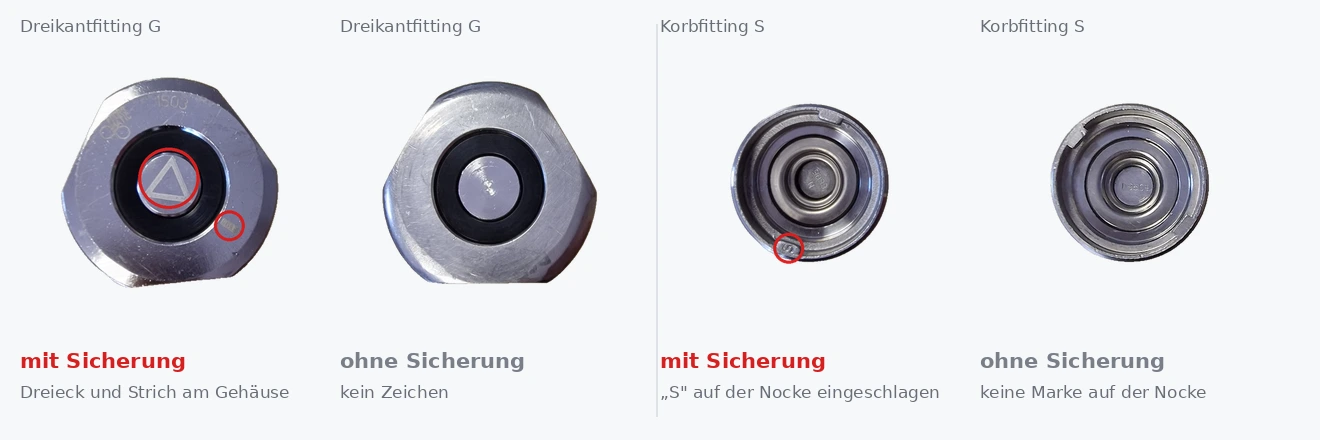
On a keg in service you only see the top of the spear – and that is usually enough. The five photographs are at one scale. The red circle sits on the mark that points to a safety catch: on the flat (A-type) and triangular spear (G-type) the lasered triangle and the strokes on the outside of the housing, on the EU Sankey (S-type) and US Sankey spear (D-type) the “S” stamped into the lug.
The same design exists with and without a safety catch. The difference is not in the shape but in the mark.
Before removal: release the pressure
A keg is under pressure even when it feels empty. Release it first, then put the tool on – no exceptions.
And treat every spear as if it had no safety catch. The catch can be sheared off, worn away or deliberately removed, and you cannot see that from above. The mark tells you what the manufacturer fitted. It does not tell you what is still there today.
The types in pictures
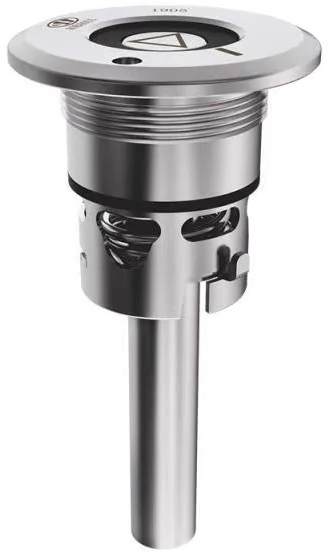
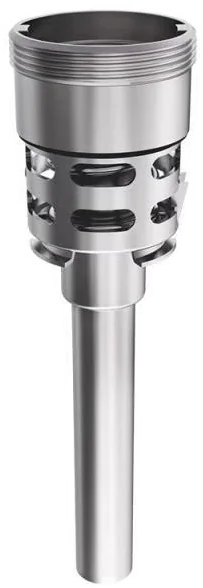
Photographs from the delivery range. We do not yet have a picture of the type L soft-drink spear.
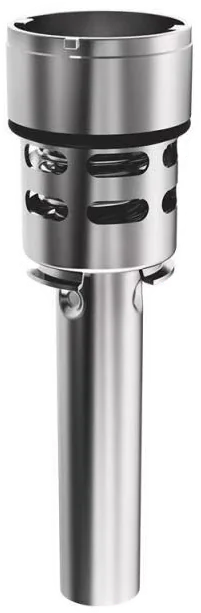
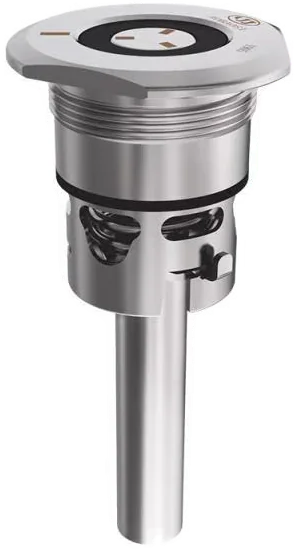
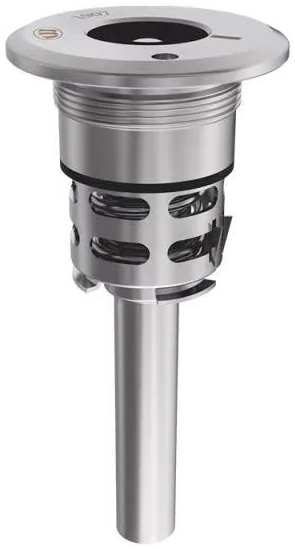
The spear is not an accessory. It is the safety-critical connection between vessel and system, and it is subject to its own standards – DIN 3542 for the spears themselves, DIN 32677 for the matching couplers.
A special case with old stock: kegs from the nineteen-eighties frequently carry a coarse thread in the neck – round thread in the sizes Rd 52, Rd 52.8 or Rd 53 instead of the standard thread. Particularly often on polyurethane-jacketed designs. The kegs keep running perfectly well, but they need their own spears. Rule of thumb for goods-in: an old year of manufacture plus a polyurethane jacket means measure before you order.
A figure worth knowing: there is a flat spear (A-type) version with 68 mm instead of 74.5 mm – and it always has a left-hand thread, just as every left-hand-thread flat spear (A-type) measures 68 mm. Both features only ever occur together. Because 68 sits noticeably below the family’s own standard of 74.5 mm, it is easily mis-sorted when measured roughly.
Why no body diameter is given for the US Sankey (D-type) and the EU Sankey spear (S-type). That is not a gap in the data but a different construction. Flat (A-type), triangular (G-type) and combi spears (M-type) have a body that sits on the neck – which is why, at 74.5, 70 or 68 millimetres, they are consistently larger than the thread. The US Sankey (D-type) and the EU Sankey spear (S-type) work differently: the body sits inside the neck, and above it there is nothing to measure.
And there are two versions of it – this is the point that decides fit or no fit when purchasing:
- US Sankey (D-type) with thread. Standard thread 2 inches × 14 threads per inch, as with the other types. Fits every normal European neck.
- US Sankey (D-type) without thread. The body is sunk into a threadless neck and held there with a retaining ring. It is held by locking lugs that engage in the neck – not by a collar resting on top. According to our manufacturer's production drawing the component measures 53.7 mm across the locking lugs, the immersed body 50.2 mm and the upper opening for the coupler 38.9 mm; below the spear seat the neck narrows to 44.4 mm. This design comes above all from the British and American markets.
Both versions come in at around 50 millimetres – the thread at a nominal 2 inches, 50.8, the threadless body at 50.2. It is the same size twice over, only held in two different ways: once by the thread, once by the retaining ring. Which is exactly why the US Sankey (D-type) does not belong in a row with the 74.5, 70 and 68 millimetre bodies: it is not in that category at all.
In practice that means a keg with a threadless neck will take no standard spear, whatever the type. Anyone taking such kegs into a European fleet needs the neck conversion to a standard thread first – after that every common spear fits.
For goods-in, the rule that is faster than any figure still applies: you recognise a US Sankey (D-type) by the fact that there is nothing to measure. If there is a body above the neck, it is not one. And the second question after that is not "how big", but "with or without thread".
What is inside a US Sankey spear. Eight parts, and the distribution of the materials explains why the cleaning limits are as they are: body, ball, down tube, both springs and the retaining washer in stainless steel 1.4301, the CO₂ valve and the sealing ring in EPDM. The steel withstands everything a washing plant runs. The rubber does not – and that is why the temperature and concentration limits are where they are.
The soft-drink spear is not a beer spear. The L system is designed for soft drinks and wine and withstands up to 7 bar instead of the 3 bar of beer spears – more heavily carbonated drinks need that. There are three designs, and the diameter tells you which: 60 mm is the general soft-drink version, 56 mm and 58 mm are two brand-specific variants that go only to licensed fillers. Anyone who finds a 56 or 58 mm spear at goods-in does not have a special beer keg in front of them, but a soft-drink keg belonging to a particular group.
How to recognise the locking variant. On the EU Sankey spear (S-type) the design is shown on the lug: no marking means the older version without a safety hook, III or R means a safety hook is present but not fixed to the body, S means the safety hook is welded on. The three need different seals – anyone who overlooks this orders the wrong set. There is also a threadless version that is held by a retaining ring and has an O-ring instead of the square seal; recognisable by the notch and the retaining ring when installed. The same system exists for the flat (A-type) and the combi spear (M-type).
Fine thread or coarse thread – just count. The standard thread with 2 inches and 14 threads per inch needs about ten turns before the spear is seated. A coarse thread is tight after three to five turns. That is the quickest distinction when no caliper is to hand.
The full comparison of all five types – with dimensions from the manufacturing drawings, parts lists and exploded views – is in the article The five spear types, finally explained.
Type G is not a system of its own. The triangular spear (G-type) is internally identical to the flat spear type A – same body dimension, same valve construction. The difference is a triangular instead of a round body, which calls for a different coupler. For you this means: spare parts are interchangeable between the two, couplers are not. And anyone who wants to convert a G fleet to A does not have to touch the neck at all – depending on availability, replacing the spear head is enough, because down tube, spring and valve are identical.
What decides the matter is the neck, not the spear. Almost every European keg carries the same standard thread – 2 inches with 14 threads per inch – and flat (A-type), EU Sankey (S-type), combi (M-type), type G and US Sankey (D-type) all sit on it. Changing system is therefore, as a rule, a parts swap, not a conversion. Real work on the keg itself only becomes necessary with threadless necks, of the kind that come from the British and American markets.
A detail regularly overlooked when assessing a keg: the retaining ring is a single-use part. It belongs to the threadless systems, where it holds the spear in the neck; every removal calls for a new one, together with the seal and the CO₂ valve. A screw-in spear has none – there the thread holds, and the safety device is an internal safety hook.
Never rely on a visible safety device. On an installed keg there is no way to tell whether a spear has a safety hook. The type designation and the laser mark on the body are hints, not certainty – hooks do get cut off afterwards, and that has already caused accidents. Depressurise before every removal, without exception.
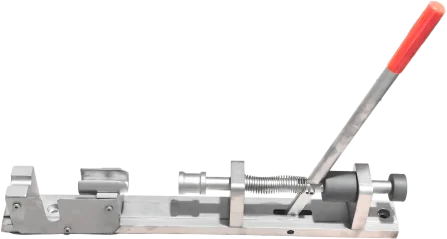
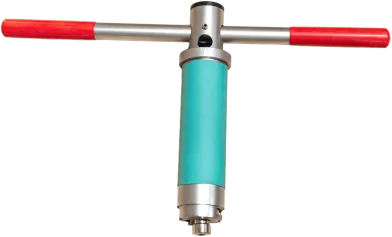
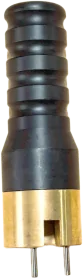
Tools for removal and spear
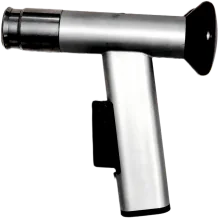
Every spear family has its own tool. Improvising damages the neck thread or the safety catch – both cost more than the right wrench.


PFAS on the thread – a question hardly anyone is asking yet
Threads on stainless steel components are often coated so that they do not gall when screwed in. Widely used for this: PTFE-based dry lubricant coatings. PTFE, known in everyday life as Teflon, belongs under the OECD definition of 2021 to the PFAS group of substances – the forever chemicals whose restriction the EU is currently deciding on. A proposal from five member states has been on the table since January 2023; the Commission is expected between the end of 2026 and the beginning of 2027.
There is no ban affecting spears so far. Aobaosi spears nevertheless already come without PFAS in the thread coating – voluntarily, ahead of any obligation. For a fleet meant to run twenty years that is no side issue: what you fit today will sit, five years from now, in a legal framework that is only being written at the moment. The legal position in detail.
Spears, spare parts and the compatibility matrix
Aobaosi is an independent manufacturer; we handle distribution in Europe. Delivery is from our high-bay warehouse with 2,300 pallet spaces, not from overseas. Once payment has been received, dispatch is possible the next day up to 12 noon, with no customs clearance.
Why we settled on these spears. We provide the European warehouse for Aobaosi and we are convinced by the quality of the parts – they are a cost-effective alternative to the established brands. The manufacturer is no newcomer: it has been making keg necks for more than 26 years and spears for more than 20. Its necks are fitted by leading manufacturers, in Europe as well.
And if the standard length does not fit: we cut spears to size – dispatch then within two to three working days. There you will also find a searchable overview of which coupler suits which brewery brand.
Go to AobaosiCleaning runs through the spear
For cleaning, the keg is turned upside down and coupled to the plant. The medium enters through the down tube and leaves again through the annular channel. If you want to understand why a bent neck is a genuine reason to scrap a keg, watch the sequence: Keg cleaning in section.