The one distinction that puts everything in order
Sorting spears by country does not get you far. Sorting them by body shape does not quite work either. The order that holds is on the inside:
One valve – type A and G
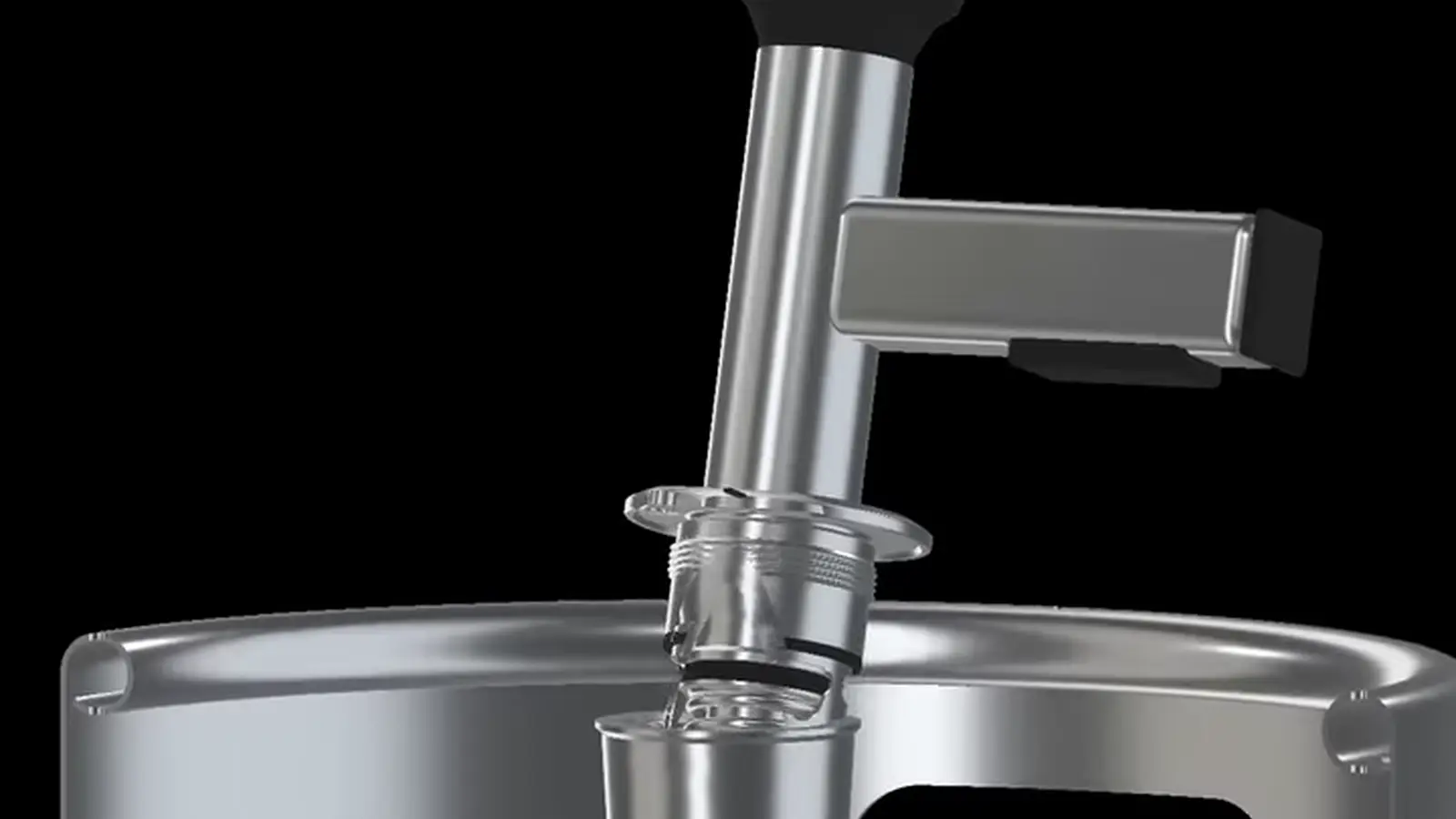
A single valve disc pressed against the seat by a spring. The coupler pushes it open, and the same path carries gas in and beer out – separated only by the geometry of down tube and annular channel.
Six parts. Simpler, fewer points of wear.
Two valves – type S, D and M
A beer valve of its own and a CO₂ valve of its own, each with its own spring. The coupler pushes both open separately.
Seven to nine parts. More elaborate, but with separately routed paths – and two springs that age.
This is not a subtlety for designers. It decides how many wear parts are replaced at an overhaul, how many springs can lose their characteristic curve, and how a coupler has to be built so that it fits.
The matching tool
The coupler finder answers this question for 1,024 brands from thirteen countries – and states on every line how well it is documented. Freely accessible, no sign-up. Look up a brewery
All five side by side
The dimensions come from the assembly drawings of the manufacturer whose European distribution we handle – that is, from production documents with tolerances, not from catalogue texts.
| Type | Design | Flange Ø | Mounting | Body Ø | Opening Ø | Valves | Parts |
|---|---|---|---|---|---|---|---|
| A Flat | round flange, flat | 74,5 ± 0,1 | 2″ × 14 TPI | 48,2 | 36,7 | 1 | 6 |
| S EU Sankey (S-type) | well-type design, no flange | – | 2″ × 14 TPI | 48,1 | 19,3 | 2 | 9 |
| D US Sankey (D-type) | well-type design, locked | 53,7 * | locking lugs | 50,2 | 38,9 | 2 | 8 |
| G Three-lug | three-lobed flange, flat | 70 ± 0,1 | 2″ × 14 TPI | 48,2 | 36,7 | 1 | 6 |
| M Combi | round flange | 74,5 ± 0,1 | 2″ × 14 TPI | 48,2 | 31,8 | 2 | 7 |
All figures in millimetres. * On the US Sankey (D-type), 53.7 mm is the dimension across the locking lugs, not a flange resting on top – the part sits in the neck, not on it. On A, S, D and G the EU Sankey (S-type) measures a uniform 43.5 ± 0.1 mm; below it the neck narrows to 44.4 mm.
The view from above
The table separates the types by dimensions. On the keg the view from above does it – that is all you see of a spear in service. The photographs below are at one scale, with the perspective taken out.
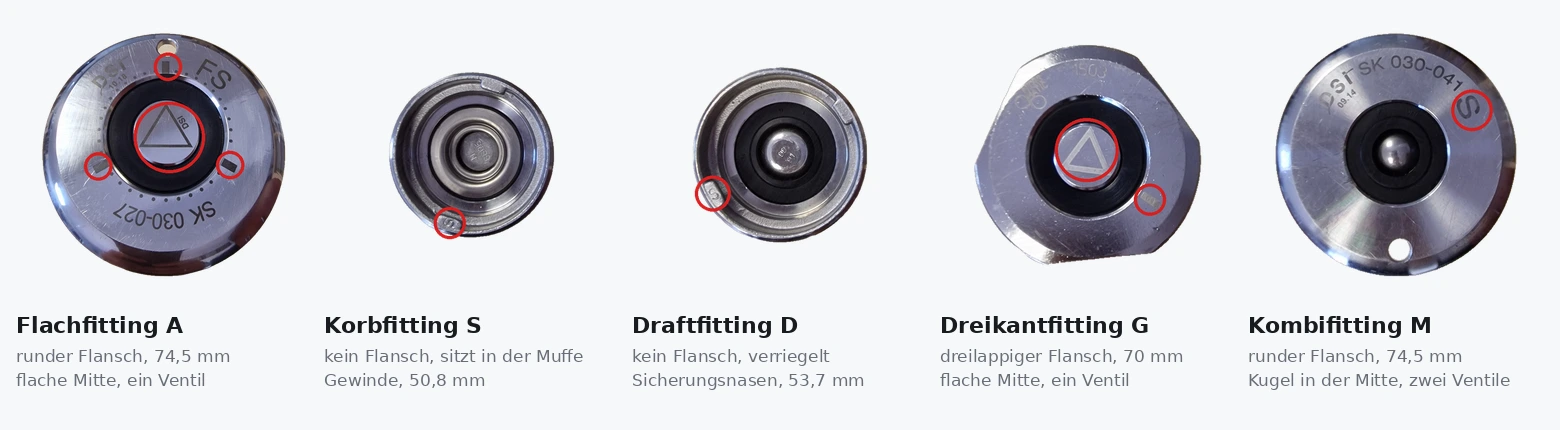
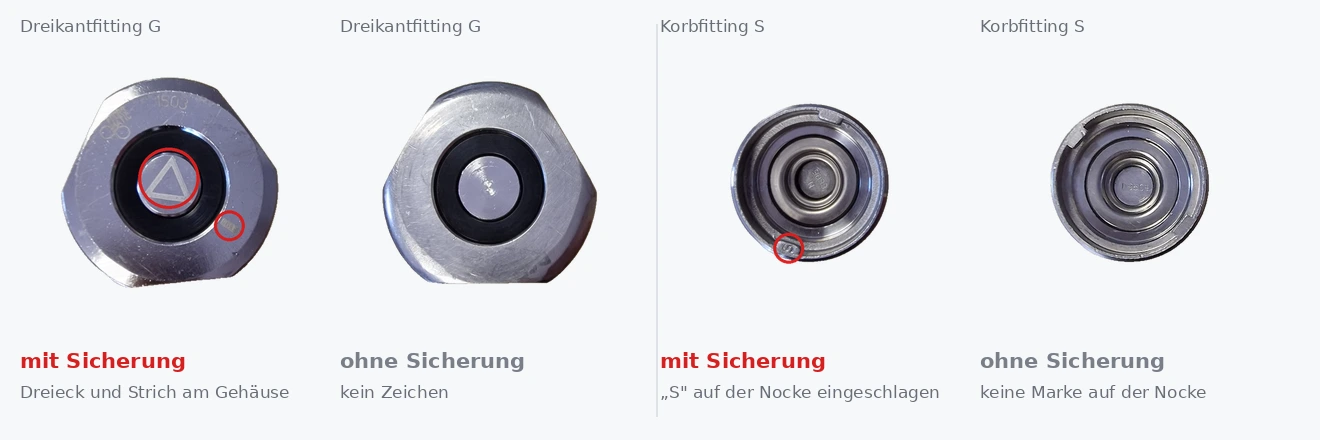
The same design exists with and without a safety catch. The difference is not in the shape but in the mark.
Before removal: release the pressure
A keg is under pressure even when it feels empty. Release it first, then put the tool on – no exceptions.
And treat every spear as if it had no safety catch. The catch can be sheared off, worn away or deliberately removed, and you cannot see that from above. The mark tells you what the manufacturer fitted. It does not tell you what is still there today.
Tools that fit here
Riser length and weight · Identify your keg · Tap head finder
Before shortening a riser, when identifying the keg type and when asking which tap head fits.
What stands out about this: Four of the five types have the same body diameter of around 48 millimetres and the same neck. They differ at the top – in the flange, in the opening for the coupler, in the number of valves. At the bottom they are more alike than the separate product names suggest.
Dismantled
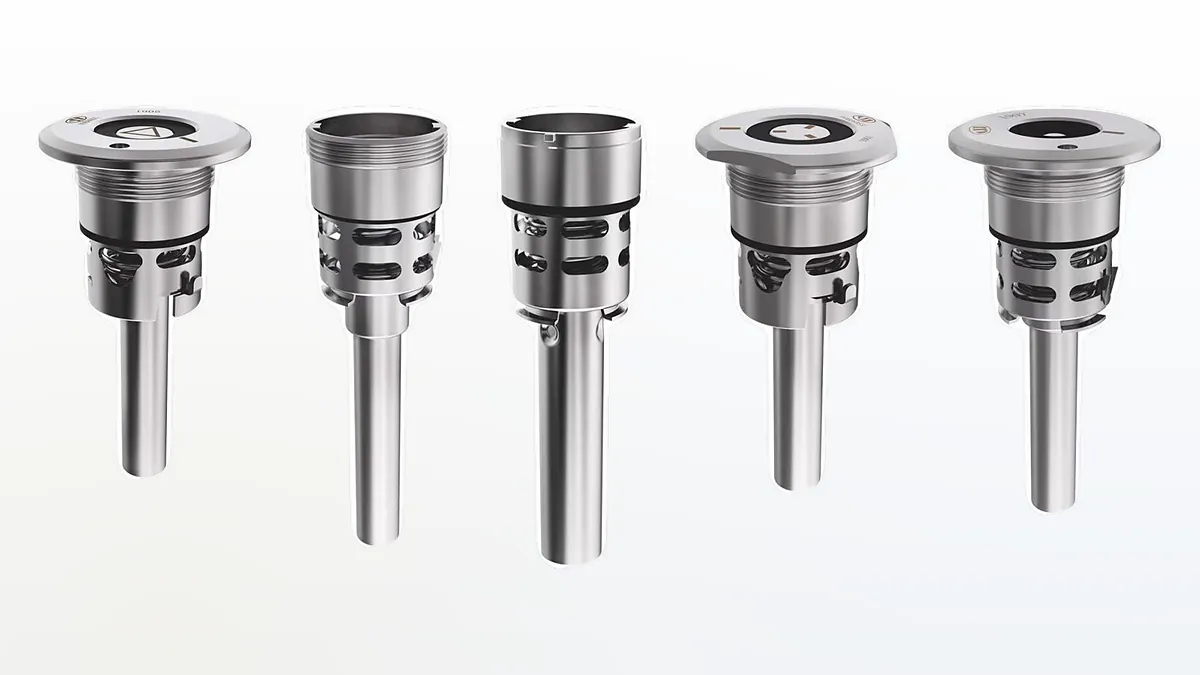
Five exploded views, all seen at the same scale. From left to right the number of parts grows.
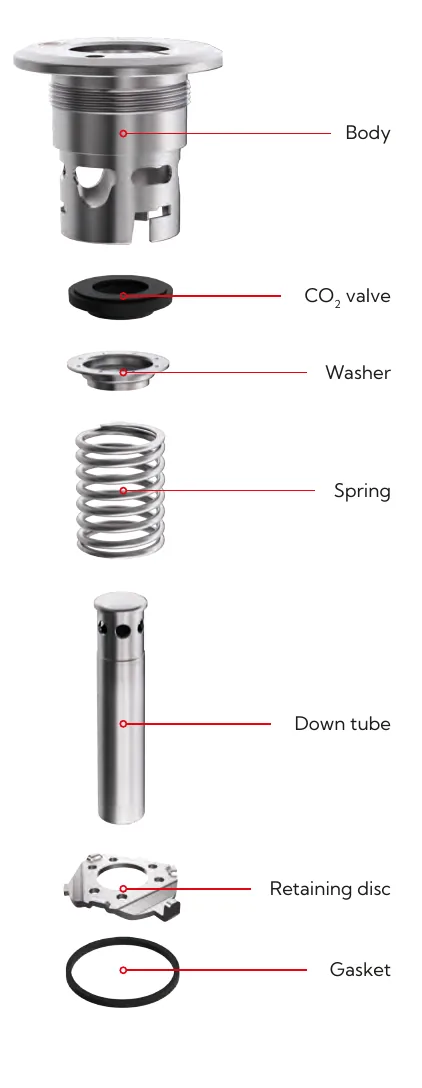
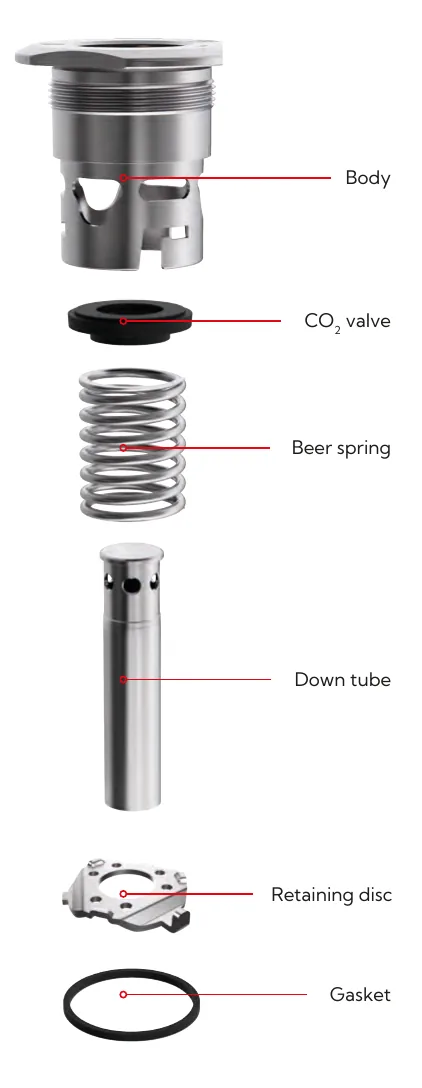
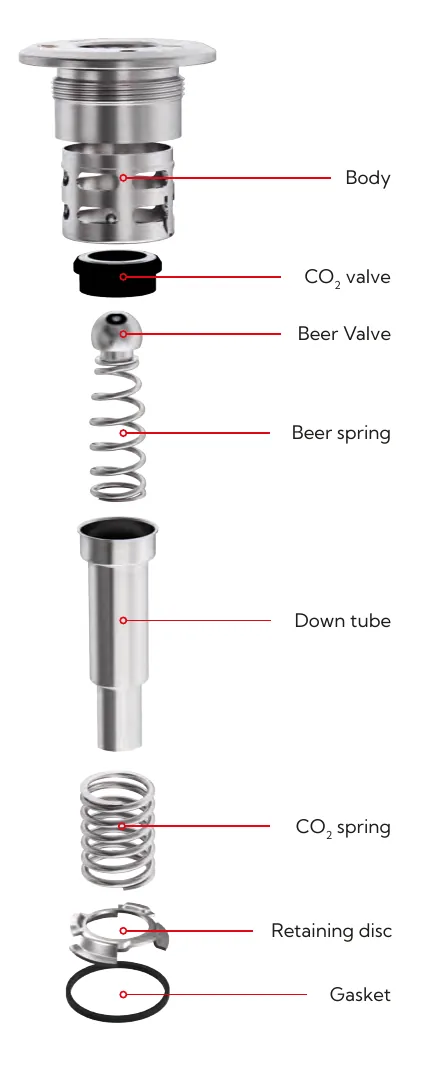
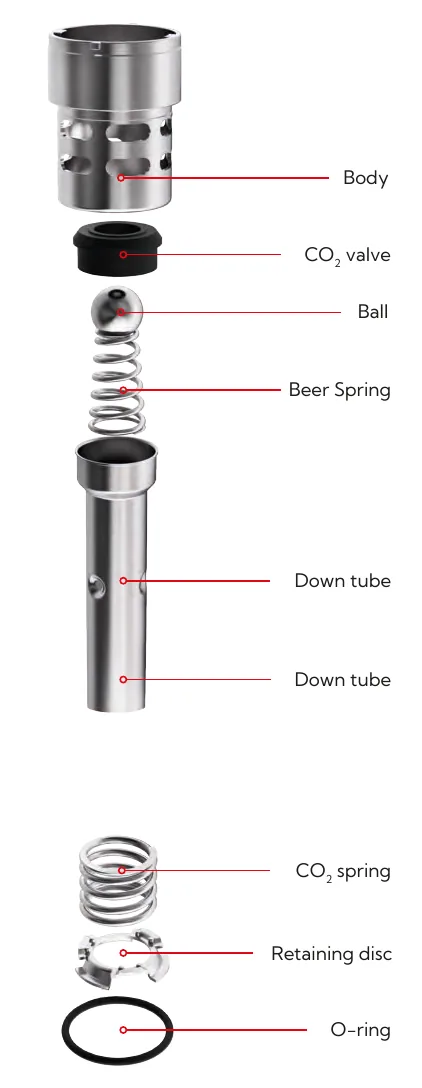
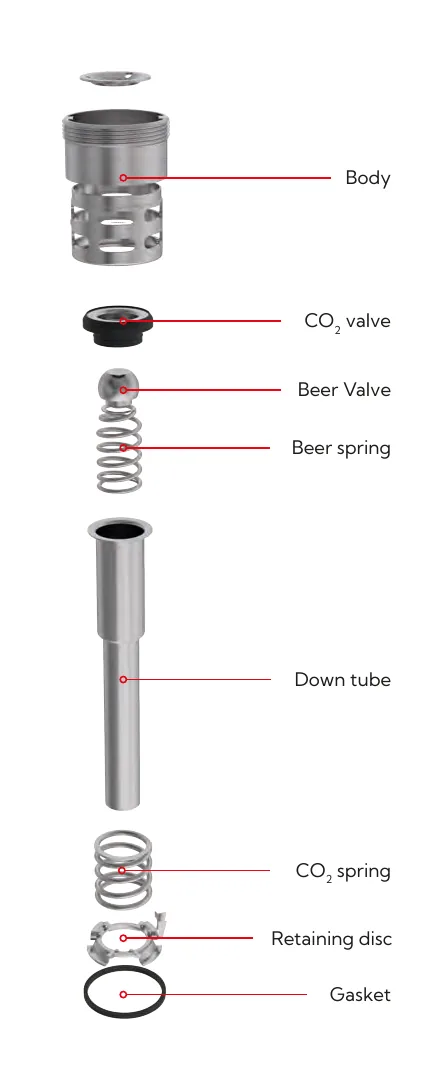
Aobaosi spears.
The finding that confirms an old workshop rule
We have been writing for some time that the flat (A-type) and the triangular spear (G-type) are identical inside. Until now that was a workshop observation. The parts lists now prove it.
| Item | Type A | Type G |
|---|---|---|
| Body | JM-AX-01-1 | JM-GX-01-1 |
| CO₂ valve | JM-AX-01-3 | JM-AX-01-3 |
| Spring plate | JM-AX-01-4 | JM-AX-01-4 |
| Spring | JM-AX-01-5 | JM-AX-01-5 |
| Down tube | CJG-HJ-01 | CJG-HJ-01 |
| Sealing ring | JM-AX-01-6 | JM-AX-01-6 |
Only the body differs – and even that only on the outside: round on the A, three-lobed on the G. The rest is the same part with the same number, right down to the down tube.
In practice this means: wear parts are interchangeable between A and G, couplers are not. If you want to convert a G fleet to A, you swap the body – spring, valve, tube and seal stay. And anyone stocking spare parts needs only one set for both types.
The year code – a detail with consequences
Two of the five types carry something that appears in no overview and that answers the most important maintenance question.
The manufacturer describes it expressly as an aid to preventive maintenance: the spear itself states which year it comes from.
Why that counts: the industry association recommends a complete overhaul of spear and down tube after seven to eight years. That is the figure most often broken in practice – not out of negligence, but because nobody knows how old the spear in the keg is. The container carries a vintage, the spear so far does not.
A year code on the spear solves exactly this problem. It turns an estimate into a reading – and turns “due at some point” into a date. Anyone running a fleet with coded spears can plan the overhaul instead of enduring it.
On the spears from our own range the year code is on the seal itself and can be read off there directly. That makes it possible to determine on the removed part when the seal should be replaced at the latest – without falling back on delivery papers or estimates.
How the code is built up on spears of other origin, and where it sits there, is not known to us.
Six parts steel, two parts rubber
The same split of materials applies across all five types, and it explains something that otherwise looks arbitrary.
Stainless steel 1.4301
Body, ball or valve disc, springs, spring plate, down tube, retaining washer. Everything that transmits force or holds its shape.
EPDM
CO₂ valve and sealing ring. Everything that seals – and nothing else.
This is why the cleaning limits are where they are
Steam at most 135 °C and at most two minutes. Caustic and acid at most 80 °C, at most ten minutes, at most three per cent. These values look arbitrary as long as you have the steel in mind – it takes them without effort.
But they are not made for the steel. They are made for the two rubber parts. Go beyond them and, out of six to nine parts, you destroy precisely the two that are meant to seal – and get back a spear that looks faultless from the outside and leaks.
Short profiles
Flat spear (A-type) – the standard
Round, flat flange, one valve, six parts. In Germany, Austria and large parts of Europe the most common type – so common that the trade often no longer states it.
To note: There is a version with 68 instead of 74.5 millimetres, and it always has a left-hand thread. Both features occur only together. Because 68 is noticeably below the usual standard, it gets filed wrongly when measured roughly.
EU Sankey spear (S-type) – the one with the most parts
Nine parts, two valves, two springs, plus a beer clip of its own. No flange – the spear sits in the neck. Common in Belgium, the Netherlands and parts of France; in the Czech Republic it leads by volume, because the big brands use it.
To note: The locking variant is marked on the lug – no mark, “III”, “R” or “S”. The variants need different seals. Overlook that and you order the wrong set.
US Sankey (D-type) – the odd one out in every table
Eight parts, two valves, a ball instead of a disc on the beer path. And the only design that does not fit into a body table: it sits in the neck and is held by locking lugs or screwed in. Common in North America, Great Britain and internationally on export containers.
To note: A keg with a threadless neck takes no standard spear, of whatever type. Only a neck conversion helps there – an operation on the keg, not a parts swap. The data sheet also names an integrated degassing function as a safety feature.
Triangular spear (G-type) – an A on the inside
Three-lobed flange, 70 millimetres, one valve, six parts – five of them with the same part numbers as the flat spear (A-type). The widespread claim that “type G is British” does not stand up to examination: we have documented it in Great Britain, Austria, the Baltic states and exactly once in Germany.
To note: Carries a year code.
Combi spear (M-type) – round flange, two valves
Seven parts, ball on the beer path, round flange of 74.5 millimetres – the same dimension as the flat spear (A-type). Common in Poland and the Czech Republic, occasional in Germany.
To note: Because flat (A-type) and combi spears (M-type) carry the same body dimension, it is not the calliper that decides here but the view from above: on the combi spear (M-type) a recessed, spherical stainless steel counterpart sits beneath the CO₂ valve of the seal; on the flat spear (A-type) the end face of the down tube lies almost flush in the seal. And: carries a year code.
In brief
The five types differ at the top, not at the bottom. Body and neck are alike; flange, opening and number of valves separate them. If you want to identify one, measure the flange first and then look at the shape – and if there is nothing above the neck, it is a US Sankey (D-type).
And the sentence that decides service life has nothing to do with dimensions at all: in every one of these spears there are two rubber parts, and they set all the limits.
Newsletter
New specialist articles as soon as they are finished
About once a month: new articles, new calculators, what is moving in standards and packaging law – and offers from our range.