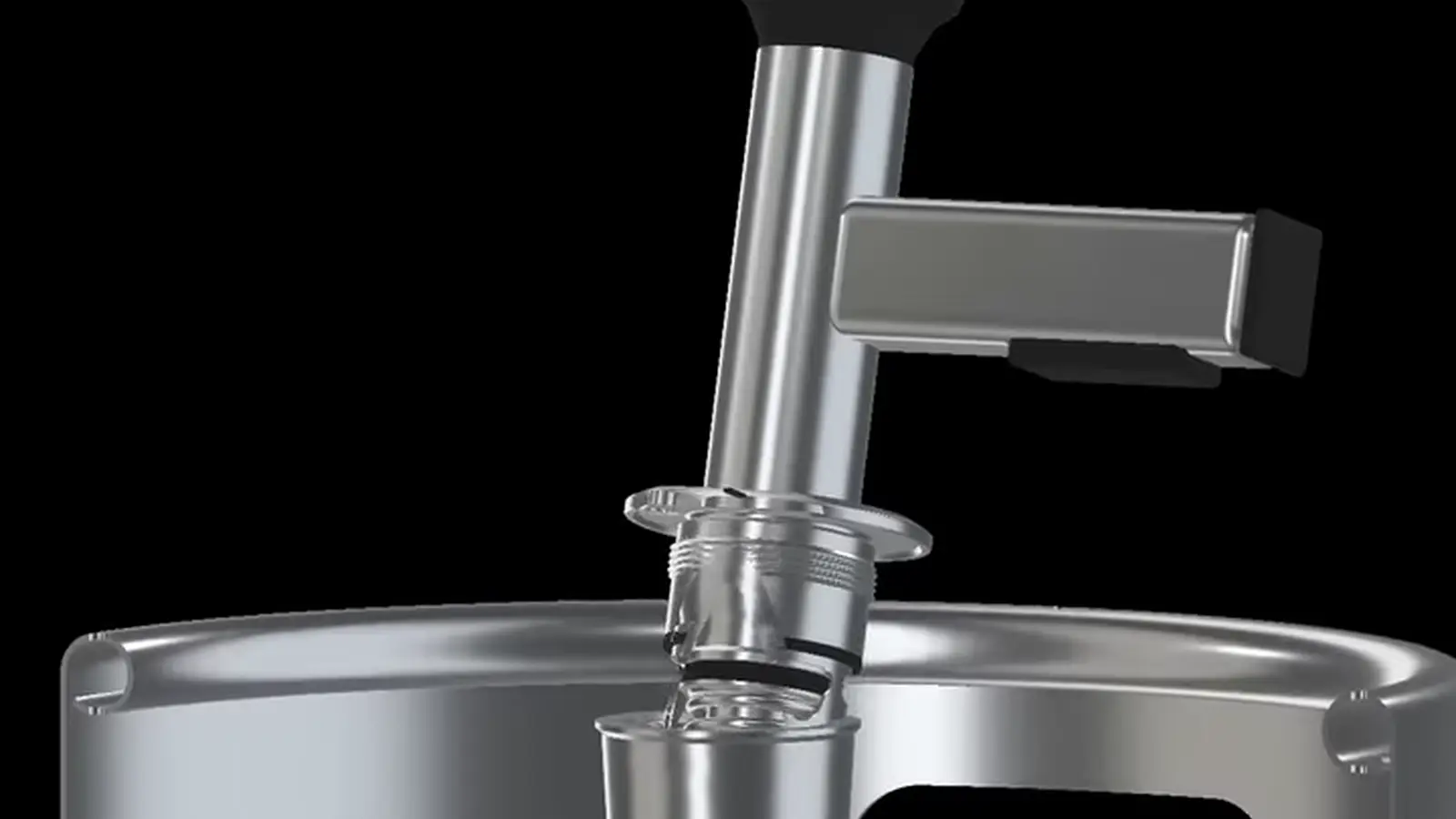
It is the question this trade asks every day and nobody answers properly: which coupler fits the keg standing on the ramp right now? Public lists exist, but they are old, partly wrong and, above all, silent about where their information came from.
We compared every list we could reach across thirteen countries, removed the duplicates, and looked at each line to see how many genuinely independent sources it rests on. The result is here in the open – including the places where it is thin.
Search for a brewery
Type the name. Accents and special characters do not have to match – “Zywiec” finds “Żywiec”, “Prazdroj” finds “Plzeňský Prazdroj”.
The country is always the brand’s country of origin. Where the same brand runs on a different type in another market, that market is named in the line itself – “NL-Markt” on a Belgian brand, for instance. Where the evidence comes from is in the note.
One sentence that matters more than the whole table
A line marked “thin evidence” is a pointer, not a commitment. It rests on a single source, and in most cases that source is the trade, not the brewery. Anyone ordering couplers or converting kegs on that basis should measure first. How to tell flat (A-type) and EU Sankey (S-type) apart in seconds is explained in the spear-types article.
The four evidence grades
Not every line is worth the same. So every line carries what it rests on.
| Grade | What it rests on | Count |
|---|---|---|
| documented | A primary source names the type explicitly: the brewery itself, its own information sheet, a data sheet or a manufacturer statement. A single primary source counts here. | 118 |
| plausible | Several independent sources agree – independent meaning: not copied from the same template. | 404 |
| thin evidence | The entry rests on a single secondary source. Usable as a pointer, not as the basis for an order. | 498 |
| contradictory | The sources disagree and we could not resolve it. We show the contradiction instead of picking a side. | 4 |
Almost half of the entries rest on a single secondary source. That is the most uncomfortable figure on this page, which is why it sits at the top and not in the small print. Anyone using a list without such grading carries the same uncertainty – they just cannot see it.
Why “eight sources” is often one source
A good dozen specialist retailers and dispensing companies publish a keg list on their own site. Most of them are word-for-word copies – recognisable by the same quirks, down to the same typing errors and the same wrong town names. What remains are essentially three independently maintained family trees.
That leads to something regularly missed in questions of assignment: eight hits from the same template are one record, not eight. Decide by majority and you are counting copies. The grading therefore counts source families, not places found – and where that could not be separated cleanly, the note says so.
The spear type does not depend on the brewery alone
This is where any list with one line per brand falls short in principle – ours included.
Same brand, two couplers
In the Netherlands several AB InBev brands run on EU Sankey (S-type) in the 50 litre keg and on flat (A-type) in the 20 litre keg. In Belgium it continues: 20 l flat (A-type), 30 and 50 l EU Sankey (S-type). But the rule holds for that group, not for the market – Grolsch runs the 50 litre keg on flat as well.
The cut-off date inside the keg
A Dutch producer changed over: kegs from August 2023 have flat, older ones combi. For a return flow or a spare-parts order this is the trickiest case of all – here the year of manufacture decides, not the brand.
Same brand, two countries
Grolsch runs on flat in the Netherlands and on three-lobe in the United Kingdom. Guinness has its own head type in France, while British lists file it under flat. Anyone working in export cannot rely on a country-level statement.
Same brewery, two systems
Leffe runs on EU Sankey (S-type) across all styles in France, while in the Netherlands the Blond in the 20 litre keg runs on flat (A-type). A Franconian brewery runs bottom-fermented on flat (A-type) and wheat beer on EU Sankey (S-type) – which is why the complete lists carry it twice.
And sometimes no standard at all
Heineken France runs the 20 litre pack as a proprietary system that fits none of the five types. Such cases are rare, but they exist – and they appear in none of the public lists.
None of the freely available lists maps even one of these axes. We hold them as separate fields and put them in the note as soon as we can document them. That is far from complete.
Two rules of thumb that do not hold
“Benelux means EU Sankey (S-type)”
Broadly right, but wrong at exactly the most prominent points: Chimay and Westmalle run on flat, as do La Chouffe, Palm and Maredsous 10. And within a single group it breaks apart cleanly – Alken-Maes has Grimbergen on flat (A-type), Affligem and Ciney on EU Sankey (S-type).
“Poland means flat”
Flat prevails, but Żywiec, Łomża and Brackie run on combi. In Poland combi is a real second standard, not an edge case. And group membership is no help: Żywiec combi, Warka flat, Leżajsk flat, Namysłów combi – all four in the same group.
In France, by contrast, group logic does hold: the Carlsberg portfolio flat throughout, the Heineken portfolio EU Sankey (S-type) throughout. Such patterns are useful, but they are hypotheses, not evidence. In this table every line is graded on its own – even where the pattern looks obvious.
What came out country by country
Czechia – the best evidence anywhere
Two independent Czech trade sources each list around a hundred breweries by head type and agree on every name we checked. It is the only country list that passes that test. The result: Czechia is clearly split three ways.
| Type | Breweries | including |
|---|---|---|
| Type A plochý | around 40, leading by count | Staropramen, Bernard, Svijany, Krušovice, Starobrno, Zubr, Litovel, Holba, Braník, Březňák |
| Type S bajonet | around 45, leading by volume | the entire Prazdroj block: Pilsner Urquell, Gambrinus, Radegast, Kozel – plus Budvar, Primátor, Rohozec, Ferdinand |
| Type M kombi | eight, clearly delimited | Chodovar, Černá Hora, Herold Březnice, Hubertus Kácov, Valášek, Kofola, Břeclav, Vyškov, Hostan |
The combi group has three records behind it: both Czech sources plus a Polish manufacturer list naming the same eight breweries. An independent confirmation in another language – in this field it hardly gets more solid.
Austria – three types in one country
Austria was the weakest point for a long time: not a single Austrian keg list, and the German ones barely cover the country. The breakthrough came through two kinds of source nobody had evaluated before.
First: beverage wholesalers who write the spear into running text. At a Lower Austrian delivery wholesaler the word sits in the middle of the beer description – “flat spear” for one brand, “EU Sankey spear” in the same position for the next. No filter, no data field: one word in a description that nobody notices while shopping for beer.
Second: a brewery information sheet for its dispensing customers. Braucommune Freistadt publishes a sheet titled “Zapfbetrieb” whose page 3 puts three columns side by side – flat spear (A-type), three-lobe flat spear (G-type), EU Sankey spear (S-type) – with the brands listed underneath. It is the cleanest primary source we met across thirteen countries, and it clears up two assumptions at once: Austria is not uniform, and the triangular spear (G-type) genuinely occurs there.
In the entire German list landscape, type G appears exactly once. In passing, the common label “British design” fell apart: a German specialist retailer sells the three-lobe head expressly as matched to the kegs of an Estonian brewery. Type G is therefore documented in the United Kingdom, in the Baltics and in Upper Austria – a clean country assignment does not exist.
Germany – the largest set and the worst documented
751 entries, and still the weakest pass. The reason is telling: because almost everything in Germany is flat spear (A-type), the trade does not write it down. It appears exactly where things deviate or where a range is mixed. A retailer in Hanover puts the type in brackets in the pack-size line – but only for nine of roughly a hundred and thirty keg items. The statement is an exception signal, not a standard field.
Turned around, that means the rule of thumb “flat unless something says otherwise” is more reliable for the German stock than anywhere else. It just cannot be documented – and that is exactly what the grading says.
Eight contradictions, checked one by one
Of 298 German brands with more than one record, eight contradicted each other. We did not settle them by majority but checked each one via brewery websites, specialist beverage retailers with the coupler in the data sheet, and dispensing-equipment rental. Three could be clarified, one turned out to be a wrong town name; the remaining four are listed as „to be checked“.
| Case | Result | Evidence |
|---|---|---|
| Esloher Brauhaus | combi (M) | the brewery itself: draught beer with a combi connection across all packs from 10.4 to 50 l |
| Warsteiner | flat (A) | a beverage retailer carries “flat keg” as a product attribute in the data sheet |
| Göller, Zeil am Main | depends on style | bottom-fermented flat (A-type), wheat beer EU Sankey (S-type) – carried as two lines in every complete list |
| Sailer | wrong town | “Oettingen” does not exist; the brewery meant is Sailerbräu Marktoberdorf |
| Erl · Farny · Schäffler · Greiz | open | every record comes from the same copied template; the breweries themselves say nothing |
The most instructive case is Esloher: there, one single list is right and all the others are wrong. A majority decision would have produced the wrong answer. That is precisely why we count source families and not places found.
The lever that changed things
After the Austrian find, a second kind of source appeared that yields even more: spears manufacturers and coupler retailers list, in the description of the coupler, which breweries it fits. The type A head carries one brand list, the type M head another. That is not a copied brewery list but a sales statement from the manufacturer – and it has to be right, or the head comes back.
In France it works even more directly: a wholesaler writes the head type into the item name. Verbatim: “BL.HOEGAARDEN 4,8° 20 L FUT Blanche (TETE PLATE)”. A Dutch retailer even maintains a data field “Vataansluiting” per item. Where something like that exists, an entire country list is documented in a few hours.
What you can do with this
If you have kegs from several markets in circulation, the table above is a starting point for taking stock – no more than that. The reliable route runs through the keg itself: measure the body diameter, determine the type, write it down. The five spear types and their dimensions and which coupler belongs on which type are covered on the blog.
If something here is wrong
Write to us. Every keg that passes through our workshop is a data point anyway – a correction from practice is worth more than any list. What helps most: brand, pack size, spear type and, if you have one, a photo of the neck bush.
We take corrections in, mark them as documented when they come first-hand, and record where they came from. What we do not do: quietly change an entry because it fits the picture better.
Report a correction or an addition · Spears, spare parts and neck-bush conversion · The spear database with dimensions and sectional drawings
Frequently asked
How do I tell from the keg itself which spear is in it?
By the body diameter. 74.5 millimetres means a flat spear (A-type); if there is no body above the neck bush at all, it is a EU Sankey spear (S-type). A calliper is enough. Two exceptions belong to the rule: there is a flat spear version at 68 millimetres, and that one always has a left-hand thread. And the triangular spear (G-type) measures the same as the flat spear (A-type) but is recognisable by its three-lobed rather than round body. With the combi spear (M-type) the measurement does not help, because it shares the flat spear's (A-type) body – there the coupler decides.
Can I rely on the entries in this table?
Only as far as the grade on that particular line goes. “Documented” means a primary source, “thin evidence” means a single secondary source – and almost half the entries fall into the second category. For an order or a conversion the table is a starting point, not proof. The reliable route runs through the keg in hand.
Why do some brands carry more than one line?
Because the spear type does not depend on the brewery alone. It can differ by pack size, market, beer style and even by the year the keg was built. Several brands run on flat (A-type) in the 20 litre keg and on EU Sankey (S-type) in the 50 litre keg. Where a brand runs differently abroad than at home, that market gets its own line – the country stays the country of origin and the market is named in the line. The Belgian brand Jupiler therefore appears twice under BE, once marked “NL-Markt”. A Dutch producer changed over in August 2023; there the year of manufacture decides.
Why is there no source count on each entry?
Because the number would mislead. Most publicly available keg lists are word-for-word copies of each other; eight hits from the same template are one record, not eight. What matters is not the quantity but the kind of source – and that is what the grade, and where needed the note, says.
Is there a universal coupler or an adapter?
No. Every spear needs exactly the matching coupler, and adapters are not a good idea on a pressure vessel. If a fleet cannot be tapped in the target market, converting the neck bush is usually cheaper than a second fleet of kegs.
What does it cost to use, and do I have to sign up?
Nothing, and no. The table is freely accessible, without sign-up and without a contact form. We are glad to receive corrections from practice – that is the only return we hope for.