The component everything depends on
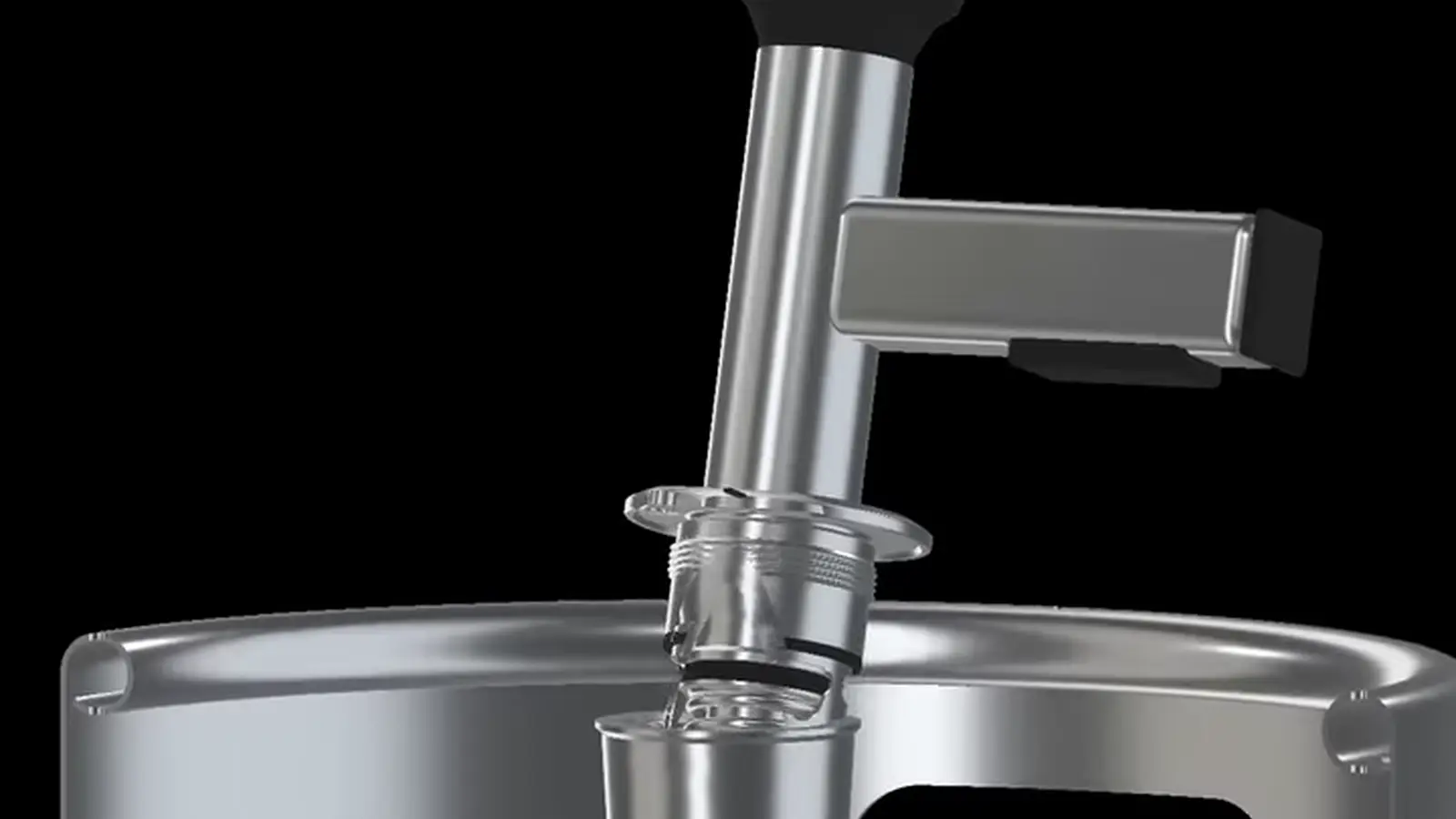
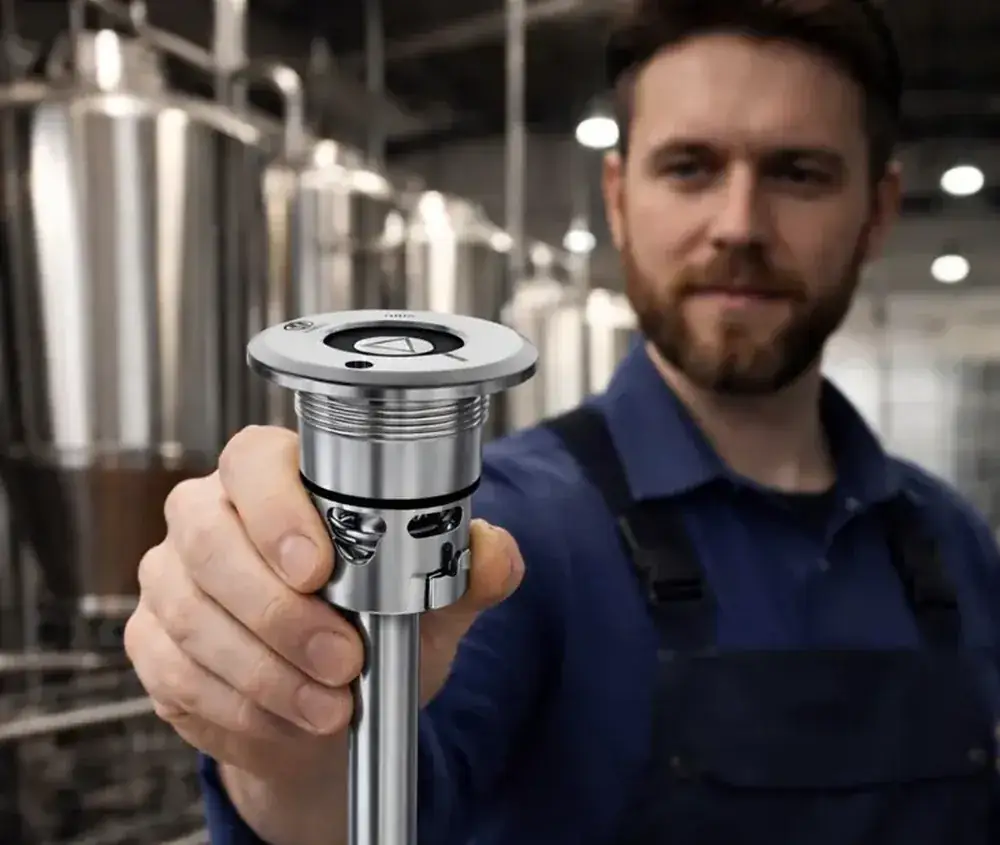
The keg body is a piece of stainless steel. It does not tire. The spear, by contrast, is made up of springs, valves and seals that go through every trip: pressure on, pressure off, hot caustic, cold beer, coupler on, coupler off.
That gives one keg two entirely different wear curves. The body lasts decades, the spear a few years. Treat both the same and you either replace whole kegs too early or the seals too late.
The cleaning runs through the spear.A tired spear does not only mean that beer flows more slowly. It means the CIP no longer reaches everywhere.
Six steps
Removal and incoming inspection
The spear is taken out and checked for visible damage: EU Sankey spear (S-type) or flat spear (A-type), condition of the thread, condition of the neck in the keg.
Disassembly and measurement
Completely stripped down. Every single part is checked against the tolerances. Anything outside them is replaced, not reworked.
Ultrasonic cleaning
In the ultrasonic bath, with biodegradable agents. Beerstone and deposits come away even from geometries no brush can reach – and that is exactly where they sit.
Replacing wear parts, measuring springs
All seals and valves are replaced – not the conspicuous ones, all of them. A single old seal in an overhauled spear undoes the whole effort. Springs we treat differently: they go through a spring test station that measures the spring pressure. Only what the measurement calls for is replaced, and that is rare – usually when a spring has been forced further together than it should have been.
Reassembly
Precision assembly with the right tools. Spears cannot be fitted hand-tight, and improvising reliably takes its revenge here.
Final test and refitting
Leak test, then installation in the keg with electronically controlled torque, around 75 Nm with us. Calibrated and reproducible, not by feel.
Where the figure comes from
Exactly one figure is publicly documented, and it is a lower limit: in its Performance Guidelines for Refillable Kegs the Brewers Association recommends a minimum application torque of 540 in-lbs, that is 61 Nm, for threaded stainless steel down tubes in stainless steel kegs. No target value and no upper limit is given there, and none of the spear manufacturers publishes a figure of its own in a publicly accessible form.
Our roughly 75 Nm sits deliberately above it – far enough to cover the spread of the plant, and far enough below what a neck thread will take.
Too loose: the spear does not seal, and the joint carries loads it is not designed for. Too tight: the neck thread is damaged, and that is the safety-critical connection between vessel and valve. Neither can be seen on the keg from outside.
When a spear is due
Several of the large manufacturers give the same rule of thumb: at the latest every seven years the spear should be overhauled and the seals replaced. This interval is publicly documented as a condition of a 30-year warranty on the weld seams – and it matches what we see at the bench.
Seven years, though, is the upper limit for the normal case, not for every keg. Two loads shorten the interval considerably:
The filled keg in the chamber pasteuriser
On the usual brewery route the spear sees nothing of the pasteurisation: the beer is flash-pasteurised before filling, around 72 °C for 15 to 30 seconds, and reaches the keg already treated.
It is different at operations that run the filled keg into the chamber pasteuriser – fruit-juice producers, pressing houses and cider makers do this to keep product quality uniform across the whole batch. There the spear goes along with it: at least 63 °C for around half an hour, and that with every filling. Tunnel pasteurisation is out of the question for kegs; it is designed for bottles and cans.
And the 63 °C is not what the spear sees. It is the target temperature in the product. For the heat to get there in a reasonable time, the pasteuriser runs considerably hotter on the outside. During heating, the keg wall and the spear sit far above the product temperature without quite reaching that of the heating medium. From practice we have been told of a brewery that briefly heats at around 120 °C in order to reach the 63 °C inside the keg.
That is no exaggeration but can be checked by calculation: chamber pasteurisers are heated with steam, and one plant manufacturer names a required steam pressure of 0.5 to 1 bar for this – and at 1 bar gauge pressure saturated steam is at exactly 120 °C.
That is exactly where it gets tight for the seal. EPDM comes in two cure systems, and they differ markedly: sulphur-cured can be used up to around 120 °C, peroxide-cured up to about 150 °C, with the lower compression set and the better resistance to hot water and steam. Anyone heating at 120 °C is therefore at the upper edge with the sulphur-cured material.
In food and beverage engineering the peroxide-cured variant is the usual one – it is the one that appears in the relevant approvals. You cannot tell by looking at a seal. Anyone who pasteurises should therefore look up the cure system in the data sheet and not search for it in a catalogue photo.
On top of that, ageing does not rise linearly with temperature but exponentially. Taking the activation energy published for EPDM as a basis, a seal ages around nine times as fast at 90 °C and around eighteen times as fast at 100 °C as it does at 63 °C. Half an hour of heat per filling thus turns into a multiple of that in calculated load – and together with the temperature change and the pressure that builds up in the closed keg during heating, that explains the considerably shorter intervals to seal and spear replacement that we see with these customers. Anyone working this way should correct the seven years downwards from the outset.
Kegs that stand outdoors
Continuous sunlight hardens the surface of the seal until it cracks. EPDM is comparatively insensitive to UV – if cracks are visible on it all the same, the keg stood outside for a long time and unprotected. As soon as the first cracks are visible, replacement is not due soon but now. If you do not need kegs for months, it is better to put them away dry and under cover than to leave them standing in the yard.
Specific occasions, regardless of age:
- The keg dispenses unevenly or foams for no obvious reason. Before you go looking at the dispensing system, check the valve.
- It drips after the coupler is pulled off. The main seal is tired.
- Beerstone is visible in the down tube. Then it is also sitting where you cannot look.
- The keg has stood for a long time. Elastomers age even without use, and they do it faster in the warm.
- The spear has already been forced loose once. Then the question is not whether but when.
Not sure which spear is in the keg?
Our coupler finder carries 1,024 brewery brands from thirteen countries with the assigned spear type – and states on every line how well it is documented. Freely accessible, no sign-up. Look up a brewery
Which seals we fit
A spear is a matched system of spring, valve seat and seal. A seal from the wrong series fits geometrically and still does not work properly – which is why we fit nothing that only roughly matches.
What we fit is to a large extent seals from our own range, matched to the particular spear series and fully compatible with it. The EPDM comes from a Danish manufacturer. They are cheaper than the original parts, and we are convinced by them – otherwise we would not fit them and put our reputation at risk. More about this range.
A detail on the side: the manufacturer we source from originally produced as an original-parts supplier for several of the large spear brands. That is our own statement from the supply relationship; there is no publicly accessible evidence for it.
Why we built the European warehouse for Aobaosi
Spears and seals from the Far East are cheap as long as you have time. When you do not – because a batch is due, because the washing plant is standing still, because the customer needs the kegs on Friday – the best purchase price is worth nothing.
That is why we built our own European warehouse for Aobaosi. The goods are here, not on the water. That is the difference between a lead time counted in weeks and one counted in days – with the same parts and without pushing the price up. Cheap, available and fast: any two of those are easy to get, all three together only with stock on the ground.
What follows from it: spare parts in the common series ship from stock, sample parts go out immediately, and larger quantities can be planned without waiting for the next container. Ask us directly for stock and lead time.
A question hardly anyone is asking yet
The threads of some spears carry a friction-reducing coating. Some of these coatings belong to the group of per- and polyfluoroalkyl substances – PFAS. The European restriction procedure on them is under way, and what will fall under it in the end is open.
The thread coating on AOBAOSI spears is PFAS-free. The manufacturer's declaration for your supplier file is available on request.
Send in spears, or whole kegs
We overhaul spears individually or as part of a complete overhaul. For larger quantities the second route is almost always worthwhile.