Why the question is harder than it sounds
A publican takes delivery of a keg his coupler will not accept. He searches online for a “brewery → spear type” list, finds several – and they contradict each other. That is no accident.
We have collected more than a thousand assignments from thirteen countries and learned in the process that the widely circulated lists share one problem: almost all of them are copies of one another. Identical order, identical typos, in some cases brands that are not even traded in the country concerned. Anyone who finds two such lists that agree does not have two pieces of evidence, but one.
The matching tool
The coupler finder answers this question for 1,024 brands from thirteen countries – and states on every line how well it is documented. Freely accessible, no sign-up. Look up a brewery
Four dependencies that defeat every list
Depends on the container
Same brand, different keg size, different spear. In the Netherlands, several brands belonging to one large group run the 50-litre keg on EU Sankey (S-type) and the 20-litre keg on flat (A-type). In Belgium the line falls differently for the same brand: 20 litres flat (A-type), 30 and 50 litres EU Sankey (S-type).
But the rule applies to that one group, not to the market. Another Dutch brewery runs the 50-litre keg on flat as well.
Depends on the year
One Dutch brewery switched on a documented cut-off date: kegs from August 2023 carry a flat spear (A-type), older ones a combi spear (M-type). Both designs run side by side in the market, because both kegs are still in circulation.
That is the only dated changeover case we were able to document – and even there the two references come from the same source.
Depends on the market
Same brand, different country, different coupler. One Dutch brand runs flat at home and triangular (G-type) in the United Kingdom. One Belgian brand is on EU Sankey (S-type) throughout in France, while in the Netherlands the 20-litre keg of one variety is on flat. One Irish brand has its own coupler type in France and appears under flat in British lists.
Depends on the beer type
Varieties differ within one and the same brand. Documented for a Belgian abbey beer brand and for a Franconian brewery that connects its bottom-fermented beer and its wheat beer differently.
Inferring the spear from the group goes wrong
The most common short circuit runs: “they belong to the same group, so the same connection.” We worked this through for a Polish group that owns four well-known brands.
| Brand | Spear type |
|---|---|
| Brand 1 | Combi (M) |
| Brand 2 | Flat (A) |
| Brand 3 | Flat (A) |
| Brand 4 | Combi (M) |
Four brands, one owner, two spear types. Anyone reasoning from the group gets it wrong in half the cases here. The same picture in Belgium: one brewing group runs one of its brands on flat (A-type), two others on EU Sankey (S-type).
The reason is historical. Spears belong to the keg stock, not to the brand. When a brewery is taken over, its fleet moves with it – and that fleet is not converted just because the name on the building changes.
Why of all countries Germany has the worst data
For Germany – the largest draught beer market in Europe – there are the fewest entries. Not because there are no sources, but for the opposite reason:
The information appears exactly where it deviates. A wholesaler in Hanover puts the spear type in brackets in the container line – but only on nine of around a hundred and thirty keg items. On exactly the nine that are not flat.
For practical purposes that says something useful: the rule of thumb “flat unless something says otherwise” holds up better for German stock than anywhere else. It is just hard to document – because silence is not evidence.
The Czech Republic is the reverse: there, two independent specialist sources each list around a hundred breweries by coupler type and agree on every name we checked. It is the only national list that passes that test. By number the flat spear (A-type) leads there, by volume the EU Sankey spear (S-type) – the major brands of one group are on EU Sankey (S-type) without exception.
The triangular spear (G-type) is not British
One attribution persists stubbornly and we were unable to confirm it: “type G, so the United Kingdom.” We have now documented the triangular spear (G-type) in the United Kingdom, in Austria at two operations, in the Baltic states – a German specialist dealer explicitly sells the three-lobe coupler (G-type) as matched to an Estonian brewery – and in Germany exactly once, at a Thuringian brewery.
So there is no clean country assignment.
Technically it is a special case anyway: type A and type G are identical inside. The same valve, the same down tube, the same spare parts – only the body is three-lobed on the outside instead of flat. Couplers are therefore not interchangeable, wear parts are. That is a workshop observation of our own, not a standard.
The thirty seconds that replace every list
When the keg is standing in front of you, you do not need a list. You need a caliper.
This is what a spear looks like from the inside – five types, taken apart:
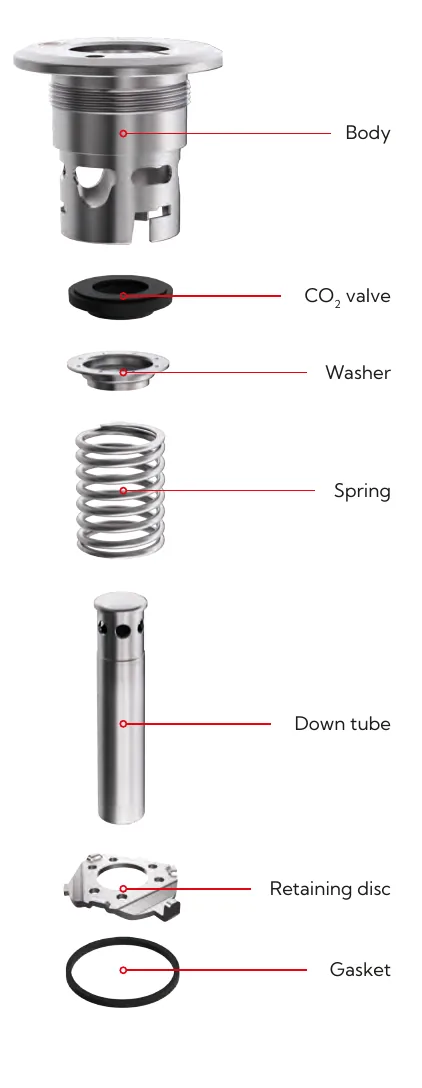
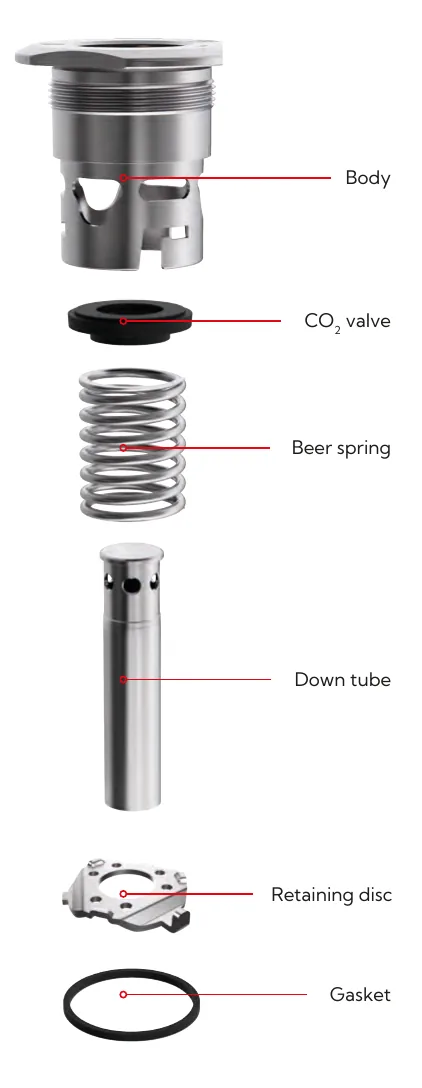
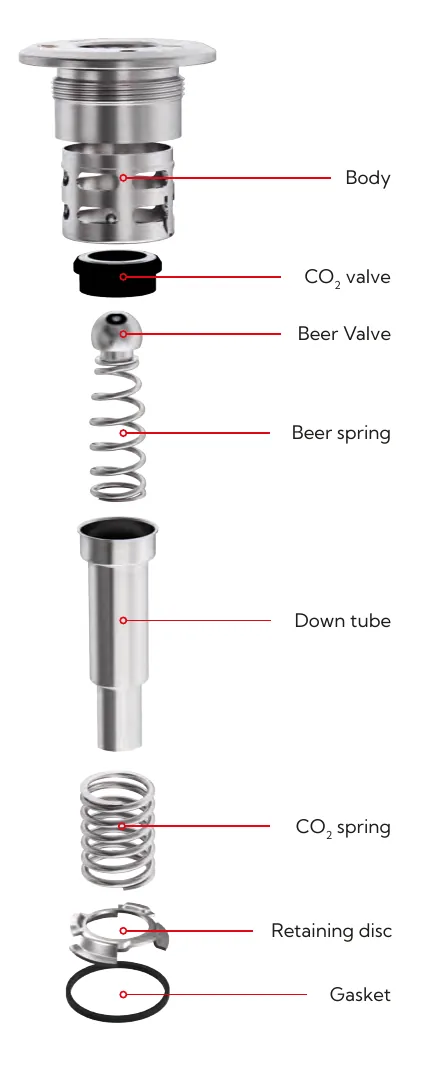
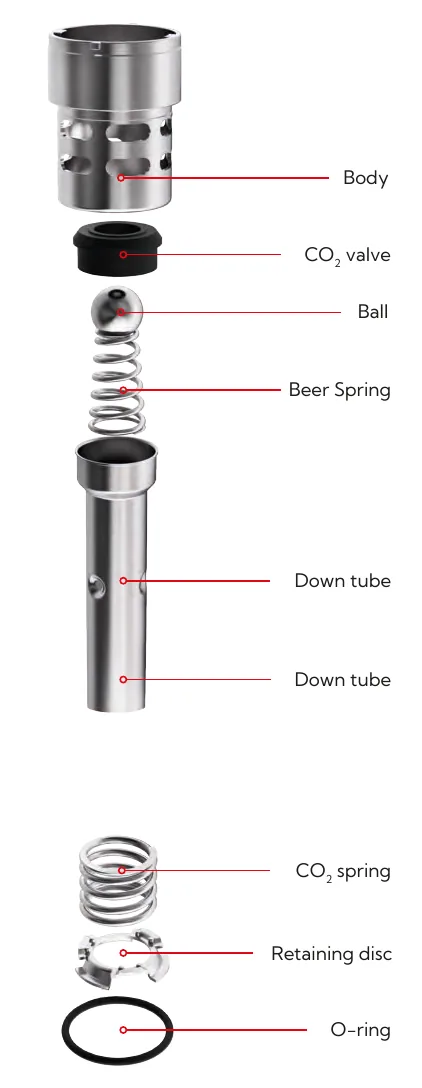
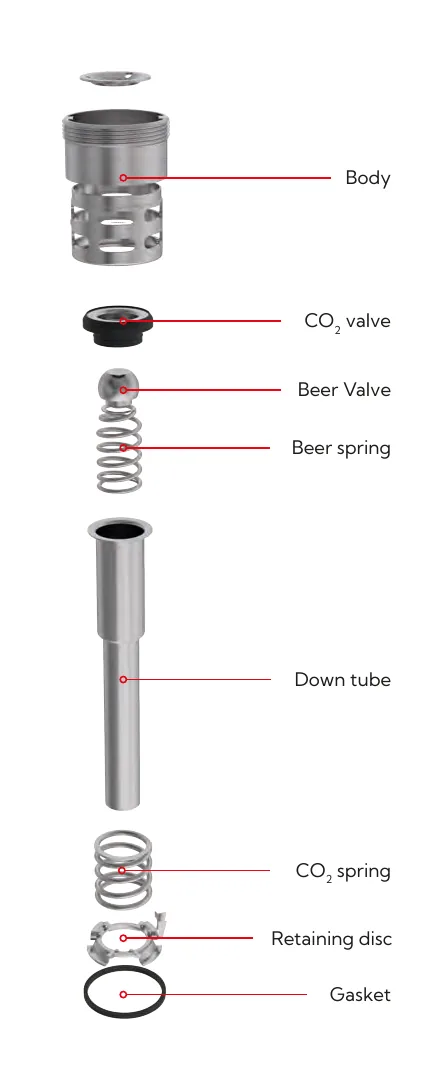
Exploded views: Aobaosi Spears.
- Measure the body diameter. The quickest and most reliable difference – and not something the naked eye can estimate reliably.
- Look at the outer shape. Round and flat: type A. Round, sitting inside the neck: type S. Three-lobed: type G. Combined with a bayonet lock: type M.
- Do not go by the thread. The neck is the same on all common types: 2 inches, 14 threads per inch. It tells you nothing at all – and that is also why a keg can be converted.
| Body Ø | Type | Watch out |
|---|---|---|
| 74.5 mm | flat spear (A-type) A, combi spear (M-type) M | two types, one dimension – here the view down into the spear decides |
| 70 mm | triangular spear (G-type) G | measured across the three-lobed flange |
| 68 mm | flat spear (A-type), left-hand thread version | occurs only with a left-hand thread; noticeably smaller than the other flat spears (A-type) and easily put in the wrong box when measured roughly |
| no body above the neck | EU Sankey spear (S-type) S | sits with its male thread inside the neck and builds inwards – nothing stands above it that could be measured |
| 60 mm | soft-drink spear, general version | not a beer spear – rated up to 7 bar |
| 58 / 56 mm | soft-drink spear, brand-tied versions | supplied only to licensed fillers |
| 2″ × 14 TPI ≈ 50.8 mm | US Sankey (D-type), threaded | no body above the neck – the thread is what counts |
| 53.7 mm across the retaining lugs 50.2 mm body 38.9 mm opening | US Sankey (D-type), threadless | is recessed into the neck and held by a retaining ring; fits threadless necks only |
The US Sankey (D-type) special case. There is no body figure for type D, and that is down to the design.The other types have a body that sits on the neck – which is why they all measure more than the thread. On the US Sankey (D-type) the body sits inside the neck and finishes flush with it.
It comes in two versions: with a standard thread of 2 inches × 14 threads per inch – fits any normal European neck – or threadless, in which case the body is recessed into a threadless neck and held by a retaining ring. It is held there by retaining lugs that grip into the neck – not a collar resting on top, but a lock that disappears into the neck. According to the manufacturer's drawing the part measures 53.7 mm across the retaining lugs, the inserted body 50.2 mm and the upper opening for the coupler 38.9 mm. The threadless design comes mainly from the British and American markets.
Eight parts, two materials
The manufacturer's drawing breaks the US Sankey spear down into eight items: body, CO₂ valve, ball, beer spring, down tube, CO₂ spring, retaining washer, sealing ring.
Six of them are stainless steel 1.4301, two are EPDM – the CO₂ valve and the sealing ring. That explains why the limits for steam, caustic and acid are as tight as they are: it is not the steel that sets them, it is the rubber. Run the spear past those limits and you destroy two of the eight parts – precisely the two that are supposed to keep it sealed.
Both are around fifty millimetres – the thread at 2 inches nominal is 50.8, the threadless body 50.2. It is the same size, just held in two different ways: once by the thread, once by the retaining ring. That is why the US Sankey (D-type) does not belong in the same row as the 74.5, 70 and 68 millimetre bodies – those measure a part above the neck, and the US Sankey (D-type) has none.
For practical work that has a consequence which can get expensive: a keg with a threadless neck will not take a standard spear, of any type. Anyone taking on such kegs needs a neck conversion to a standard thread first – that is work on the keg, not a parts swap.
Out of that comes the rule that is faster than the caliper: you recognise a US Sankey (D-type) by the fact that there is nothing to measure. Where a body stands above the neck, it is not one. And the second question is then not “how big”, but “threaded or not”.
The 74.5 millimetre problem: flat spear (A-type) and combi spear (M-type) share the same body dimension. Measure alone and you have two candidates. They are separated by the view from above: on the combi spear (M-type), below the CO₂ valve of the seal sits a ball-shaped stainless steel counterpart, clearly recessed. On the flat spear (A-type), the end face of the down tube lies almost flush in the seal, level with the spear head – a flat view with no recessed ball. The caliper narrows it down, the decision is made inside the spear.
Two features that are faster than the caliper
The lug marking. On the EU Sankey spear (S-type) the retaining variant is marked on the lug: no mark means the older version without a retaining hook, III or R means a hook is present but not fixed to the body, S means the hook is welded on. The variants need different seals – miss that and you order the wrong set. The same system exists for the flat (A-type) and the combi spear (M-type).
Count the turns. The standard thread of 2 inches and 14 threads per inch needs around ten turns before the spear is seated. A coarse thread – as found on kegs from the eighties and especially on polyurethane-clad designs – is tight after three to five. That works without tools.
If the keg is not yet in front of you, our compatibility matrix will help. It holds more than a thousand entries from thirteen countries – and, which matters to us more than the number, the strength of evidence for each entry.
What we do not claim
Of the entries in our matrix, only a good tenth are documented in the strict sense – that is, supported by at least one source that is not a copy of another. Just under a third are plausible, nearly half are thin, four entries are contradictory.
We show that rating on every single entry instead of hiding it. We never communicate an entry rated “thin” as a commitment. That is uncomfortable, but it is the only way of handling this data that we can defend.
Open cases we are working on
- Four German contradictions – four breweries for which we have two sources contradicting each otherand no third. A case for measuring in the workshop.
- One Czech contradiction between the two national sources that otherwise match exactly.
- Luxembourg – after two rounds, exactly one hit from a single source.
- Austria and Switzerland remain thin; Switzerland hangs almost entirely on a single statement by one association.
If you can close one of these gaps – because you know the spear of one of these breweries yourself – write to us. We correct the matrix continuously, and we note when a figure came from outside.
In brief
There is no reliable “brewery → spear” assignment, because the spear is tied not to the brand but to the individual keg – and kegs move between container sizes, countries, varieties and owners.
What is reliable: first the look at the neck, then the caliper. If a body sits on the neck, 74.5 millimetres means flat or combi (M-type) and 70 millimetres means triangular (G-type). If the body sits inside the thread, it is a EU Sankey (S-type) or a US Sankey spear (D-type). Between flat (A-type) and combi (M-type), the recessed stainless steel ball under the seal decides. Everything else is probability, ours included.
Newsletter
New technical articles as soon as they are ready
About once a month: new articles, new calculators, what is moving in standards and packaging law – and offers from our range.