The most expensive item is the one nobody books
Kegs disappear. Not spectacularly, but slowly: one per delivery that never comes back, a few in the yard of a pub that has closed down, a dozen at the scrap dealer. In the accounts this shows up as an inventory adjustment, not as a loss – and that is precisely why it is underestimated.
Marking does not prevent this. But it shifts the odds considerably, and it does so in three places at once.
Why marking works
- It makes theft unattractive. A keg carrying another brewery's legible marking is that brewery's property – no matter who currently has it standing in their yard. Reputable scrap dealers therefore refuse to take it.
- It makes the way back possible. A well-marked keg also finds its way back to your brewery in most cases. Without a marking, a keg in someone else's yard is simply a keg.
- It makes the stock countable. Anyone who does not know which kegs are where cannot tell loss from circulation – and then plans new purchases on gut feeling.
The special case that is both
A keg whose marking has become illegible is also refused by reputable scrap dealers – because its origin can then no longer be established. The result is the same as with another brewery's keg: it does not belong in the scrap, it belongs back.
If kegs like these are standing on your premises, we take them and establish who they belong to. How that works is set out here.
The processes compared
| Process | Durability | What it is good for | Limits |
|---|---|---|---|
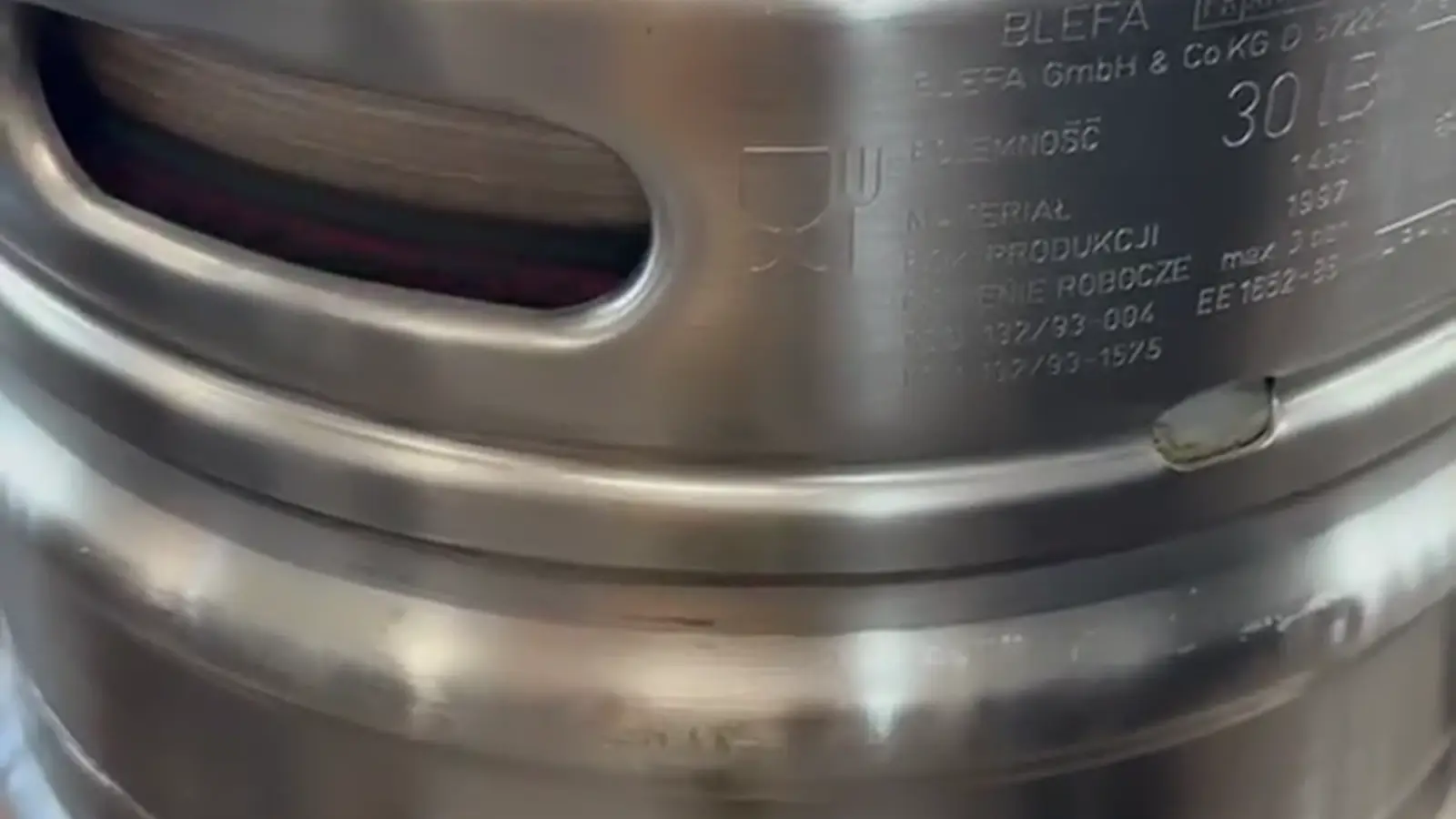
| Electrolytic engraving | permanent | Logo, lettering, serial number – greyscale included, so a genuine image as well | Needs a flat, clean surface. After reconditioning that is a given. |
| Laser marking | permanent | Logo, lettering, serial number – and above all QR codes, for which the process is particularly well suited | Like engraving, needs a flat, clean surface. |
| Machine embossing | permanent | Serial number and brewery name on the top chime, impervious to everything | No fine artwork, only text and figures. The top chime has to be aligned. Embossing is as a rule done at the manufacturer, directly when the kegs are ordered – applying it afterwards is normally not possible. |
| Metal plate | permanent | Spot-welded onto the keg, usually on the top chime – on request also over an embossed marking left by the previous owner | Can be forced off. And it covers an old embossing, it does not remove it. |
| Weatherproof label | long | Batches, varieties, temporary allocation. Our labels are protectively laminated and withstand caustic and wash cycles from outside over a long period | Still a sticker: more sensitive to mechanical damage than engraving or embossing. |
| Colour ring or band | medium | Telling varieties, volumes and vintages apart – recognisable at twenty metres | Identifies the group, not the individual keg. |
| RFID transponder | permanent | Automatic capture without line of sight, linked to an inventory system | Needs readers and a system behind them. Without that it is an expensive sticker. |
In practice you combine them. Permanent embossing with a serial number as the basis, a colour code on top of it for a quick look around the yard, and a transponder wherever an inventory system is in place.
What we are working on right now
Keg identification and return
We are building a database that allows a keg to be assigned unambiguously to a brewery from its marking, together with an exchange centre through which identified kegs go back to where they belong. A QR code is one route to that, not the only one.
A theft report is part of the plan as well. A registered keg that is reported stolen can be flagged in the database – anyone who scans it or enquires about it later sees the note. In the USA there has been a warning system of this kind for metal theft for years; in Europe there is no counterpart. For a keg whose residual value as scrap is a few euros and many times that in circulation, this is the most effective lever – theft only becomes expensive once the goods are no longer anonymous.
This is under construction and not yet in production. If you are having kegs marked now, we will set up the numbering scheme so that it fits later without a second pass.
Planning your marking
Tell us how many kegs you have in circulation and whether a numbering scheme already exists. We will turn that into a proposal.