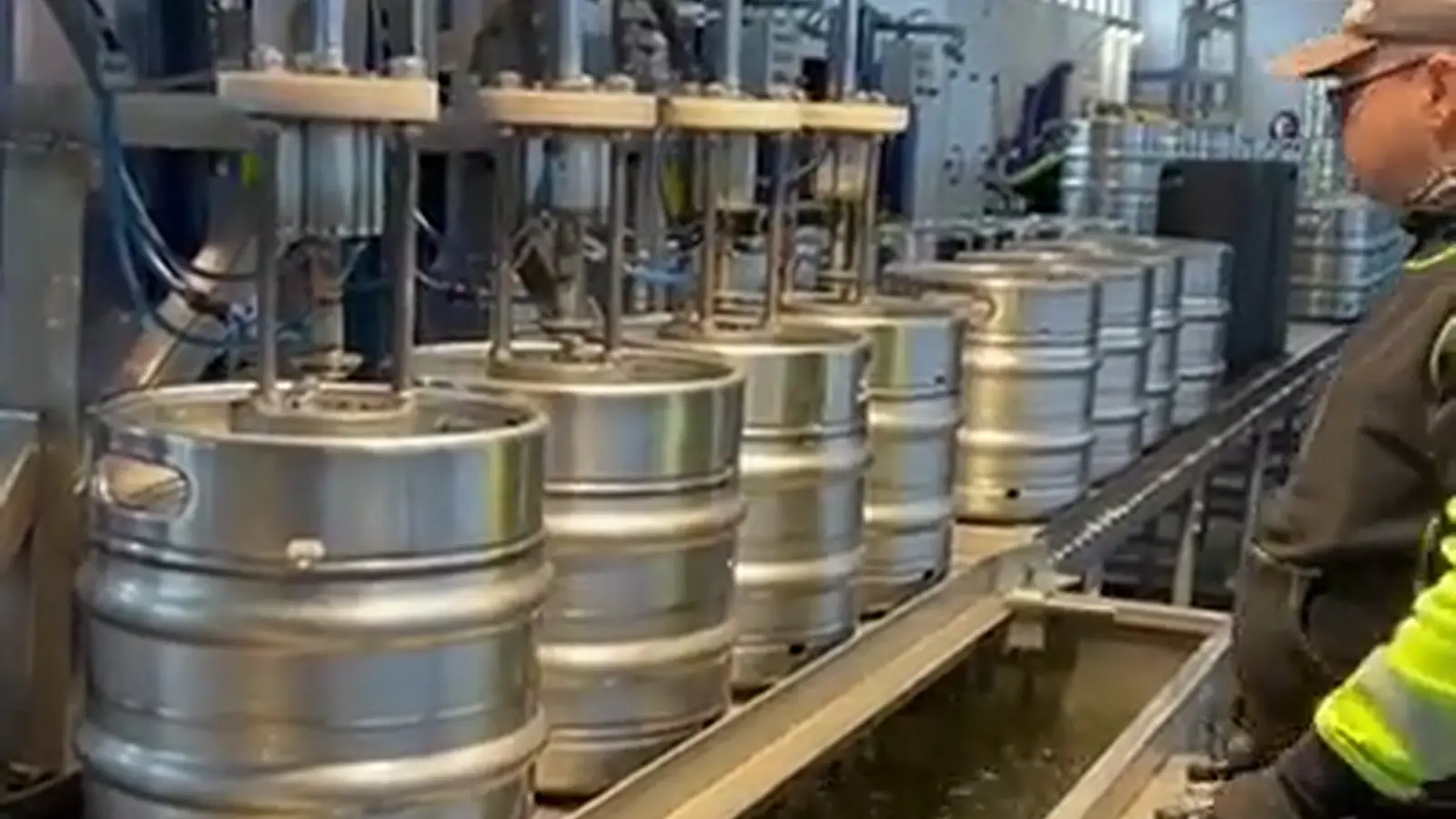
A keg has exactly one opening
That is the sentence everything else follows from. A tank has a manway, a bottle has a wide neck, a keg has a down tube with an internal diameter of twelve millimetres and nothing else. Every drop of caustic, every drop of acid and every cubic metre of steam has to pass through that one tube – and back out the same way.
Once you have that picture, it is obvious why keg cleaning is a craft of its own and why kegs can fail at it.
What the machine actually does
The sequence has been the same for decades, whatever the make and size. The figures come from the guideline of the American Brewers Association, the only freely available source that names concentrations and temperatures at all:
| Step | Medium | Values |
|---|---|---|
| Push out residual beer | CO₂ or air | – |
| Pre-rinse | water | – |
| Caustic | alkaline | 2 % v/v · 50–70 °C |
| Intermediate rinse | water | – |
| Acid | acidic | 0.2–0.4 % v/v · 50–70 °C |
| Final rinse | hot water | 50–70 °C |
| Steam | saturated steam | 1.0–2.2 bar · 110–135 °C |
For the steam step the guideline gives a typical value of 135 °C for one minute – with a condition that often gets lost in practice: the steam has to be saturated. Superheated steam transfers heat poorly; it reaches the temperature but not the effect.
Chlorinated caustic above 65.6 °C (150 °F) can seriously damage stainless steel. That is exactly inside the temperature window the caustic stage runs in anyway. Anyone using a chlorinated product in the upper half of that window is damaging their own kegs – and will only see it years later as pitting.
The same thought appears on the dispensing side: the hygiene guidelines for beverage dispensing systems state expressly that the cleaning agent may be acidic or alkaline but not chlorinated.
Two pressure stages – the point that decides the result
What follows is operating knowledge from our own workshop. It explains more about cleaning results than any concentration figure.
The medium leaves at the far end of the down tube – which, because the keg hangs upside down, is at the bottom. What happens next depends entirely on pressure:
High pressure
The jet reaches the bottom dish, breaks up there and runs down the inner walls. It wets the entire shell surface and works mechanically. This is the step that cleans the wall.
Low pressure
The medium barely leaves the tube, falls back and runs down the outside of the down tube to the spear. It cleans precisely the surface the high-pressure jet systematically misses.
Run high pressure only and you get a clean wall and a coated down tube. Run low pressure only and you get the opposite. Both mistakes are common, and neither is visible from outside.
It affects the four wet steps: pre-rinse, caustic, acid and final rinse. In the animated cleaning diagram the display switches automatically between the two stages at those points.
We deliberately give no pressure values. They depend on the machine, the keg size and the spear type, and a figure from someone else's plant would not help here – it would be a source of error.
Beer stone – and why it sits on the down tube of all places
Beer stone is not dirt in the everyday sense. It is a mineral deposit that forms where beer constituents meet a surface and are not removed in time. It is hard, it wets badly, and it is the preferred base for everything that comes after: a deposit shelters micro-organisms from caustic and acid that would act immediately on smooth stainless steel.
And it settles, in our observation, preferentially on the outside of the down tube. The reason is three paragraphs above: that is the surface the high-pressure jet does not reach. A keg with a clean wall and a coated down tube is not a rare finding but the typical consequence of a machine that knows only one pressure stage.
How you notice before you see it
Not on the keg but in the beer. A deposit carrying micro-organisms shows up as shortened shelf life long before anyone cuts a keg open. If you have returns with off-flavours and have already checked the dispensing system, put the kegs on the list of suspects.
The check: 100 millilitres
There is a surprisingly practical measure of whether a machine is working properly – and it has nothing to do with chemistry. It is the residual water in the keg after washing:
| Measuring point | Target | Limit |
|---|---|---|
| After washing, 50 to 60 litre keg | 40–80 ml | no more than 100 ml |
| After the filling head | – | below 50 ml |
More residual water means the keg was not fully drained or not blown out with gas sufficiently. That measurably dilutes the beer and brings oxygen with it. The figure is therefore a good machine indicator – and it can be taken with a scale, without a laboratory.
And the microbiological check
The guideline describes a procedure for that too: introduce one litre of sterile liquid – beer if possible – through a sterilised valve, divide it into three 100 millilitre samples, membrane-filter them and incubate both aerobically and anaerobically. The double approach is the point: part of the beer-spoiling flora grows without oxygen, and anyone incubating aerobically only will miss them.
A contradiction we cannot resolve
On acid concentration the published figures diverge widely:
| Source | Figure |
|---|---|
| Brewers Association, Performance Guidelines | 0.2–0.4 % v/v |
| A US keg pool, operating statement | 0.25–0.4 % |
| A US industry forum for brewers | 1.5–2.0 % |
That is a factor of up to ten. We give both figures. Anyone setting up a machine should take the figure from their chemical supplier, not from an article.
The other side: the dispensing system
The cleanest keg is worth nothing if the line behind it is not kept up. The intervals are in DIN 6650-6 and are freely accessible through the industry's hygiene guidelines:
| Beverage | Cleaning interval |
|---|---|
| Ready-to-drink beverages, fruit juice, nectar, milk | 1 day |
| Alcohol-free beer | 1–7 days |
| Beer | 7 days |
| Wine, carbonated soft drinks | 7–14 days |
| Syrup, spirits | 30–90 days |
| Water, table water | 90–180 days |
Two points from it are regularly overlooked. First: the coupler is rinsed and disinfected at every keg change, not only at the weekly clean – and a disinfected coupler goes back on only once the agent has evaporated. Second: at the weekly clean the coupler is taken apart, and the O-rings are then greased thinly and evenly.
This is also where keg damage starts: a coupler with a burr or a sharp edge cuts into the spear's valve seal at every connection. The damage shows up later on the keg, not on the tool. Which coupler designs exist is covered separately.
When a keg no longer gets clean
There is a point at which cleaning stops helping. Three findings lead there:
- Pitting on the shell or the bottom dish. Usually the result of a chlorinated agent or of chlorides in the rinse water. A pit holds deposit that no jet reaches.
- A down tube with firmly attached deposit. Repairable – but not by washing longer; by removal and replacement. That is a workshop job, not a machine parameter.
- A weld with a crack or a gap. A gap is a reservoir. It cannot be rinsed empty, because no jet gets in and no flow passes through.
All three are findings for a full overhaul, not for the washer. What actually happens during one and when it still pays are covered in their own articles.
Our own position
Most cleaning problems we see are not chemistry problems. They are flow problems: the path the medium takes inside the keg is different from what the operation assumes, and so the same surface stays coated every time.
Before anyone raises the concentration – and attacks their own kegs in the process – it is worth looking at how pressure is managed. A keg run alternately at high and low pressure needs less chemistry than one that knows only a single stage.