The mistake that costs the most money
A stainless steel keg weighs between seven and twelve kilograms, depending on the design. At scrap prices that comes to a two-figure sum – and that calculation is the reason why every year kegs are melted down that would have run for another twenty years and more.
Because a keg is not a piece of sheet metal. It is a pressure vessel with an operating approval, a documented test history and a valve that on its own can be worth more than the metal around it.
How long such a vessel lasts is regularly put too low. The Brewers Association performance guidelines name 60 to 180 cycles over ten to thirty years. One leading German manufacturer even gives a 30-year warranty on the tightness of all weld seams and on corrosion protection – on condition that the kegs are serviced every seven years. So a keg taken out of service after ten years has, with normal handling, not even a third of its life behind it.
What we see in our own workshop
In our refurbishment line, kegs built in the eighties and nineties are everyday business. Depending on handling and turnover they still look good after thirty years and more – and after refurbishment they are almost as new. That is not a study, it is an observation from day-to-day operations. But it is an observation on thousands of kegs, and it matches what the manufacturers themselves say about service life.
Where the “14 years” come from – and why they say nothing about service life
In debates about life cycle assessments the figure 80 uses in 14 years comes up again and again. It comes from the only independent, peer-reviewed life cycle assessment comparing steel and plastic kegs so far (Martin et al., 2022). There, however, it is not a measurement but a calculated value: the 80 uses are taken from an earlier paper, and the not quite 14 years follow purely arithmetically from the authors assuming a high turnover rate of 5.5 fillings per year – a figure from conversations with craft breweries. What is short, then, is not the life of the keg but the period in which 80 fast cycles add up.
At the same point the study writes that manufacturers point out that service life can considerably exceed 100 uses, and names “around 30 years” as the order of magnitude given by several producers.
Why the authors nevertheless calculate conservatively: because it makes their result more robust. The climate advantage of the steel keg already applies from 38 uses onwards – it does not depend on the low assumption at all. Anyone quoting the 14 years as service life is quoting the study wrongly.
This article explains what that value is made up of, what destroys it and what does not – and what you can establish yourself in ten minutes, before you call anyone.
Seven factors determine the price
In this order, and the first weighs more than all the others together.
Design and capacity – marketability
A keg is worth as much as someone can use it for. The DIN and the EURO keg with 30 litres are the standard in European dispensing – there are buyers for them at any time. The further a design departs from that, the thinner the market becomes: for special sizes and exotic versions there are fewer operations that can work with them, and that is exactly what pushes down the going purchase price.
The fifty-litre keg is currently running against the market. Demand for it has been falling for some years – while more and more of it is being offered. Larger brewing groups are parting with stock too and putting it on the open market. Supply and demand are diverging here, and for the quantities currently in circulation there is barely a market left. That feeds straight through to the price.
With the 20-litre SLIM keg it is the other way round: there is hardly any second-hand stock. The design is one of the more recent in the range, so correspondingly little of it has reached the second-hand market at all. On top of that, the kegs that exist are still in service because they sell so well. Significant used stock is therefore not available.
You can identify the diameter straight away: 363 mm is DIN, 395 mm is EURO. Anything below that belongs to one of the slim ranges. The height then tells you the capacity.
Stacking base – stackable or not
A keg with a stacking base is in far greater demand than one without. The reason is logistics: stacking happens on the pallet, in the cold store and in the van. Anything that cannot be stacked costs floor space – on every single cycle.
That feeds straight into the purchase price: there are fewer buyers for kegs without a stacking base, and that pushes the price down. A damaged stacking base, on the other hand, is no reason to reject a keg – it is restored during refurbishment, as are distorted top and bottom chimes.
Neck type – whether the spear can be changed at all
The common one is the standard thread 2″ × 14 TPI. If that is in the neck, the spear type can simply be changed when needed – a parts swap, not work on the keg itself. That makes the keg fit any European market, and that is exactly what makes it sought after.
With anything else it gets thin. Coarse threads – round threads in sizes Rd 52, Rd 52.8 or Rd 53, common on kegs from the eighties and on polyurethane-clad designs – and threadless necks will not take a standard spear. They need the matching, considerably more expensive spears, or the neck has to be converted. Both cost money, and both show up in the purchase price.
Spear type – and whether it is still the first one
The spear is not an accessory, it is a substantial part of the value. A flat spear (A-type) has a body 74.5 mm in diameter; with a EU Sankey spear (S-type) there is no body above the neck at all – you can establish that with a caliper in seconds. Common types are easier to make use of than rare ones.
What you cannot see from the outside: how the spear is secured. On the ordinary threaded spear with 2″ × 14 TPI there is a safety hook inside – it comes in several designs, and it can only be assessed once the spear has been removed. A retaining ring sitting visibly in a groove is found only on the threadless versions. For valuation that means: the condition of the spear retainer is not something you can judge on a keg standing in the yard – more on that below.
Condition – and the right kind of condition
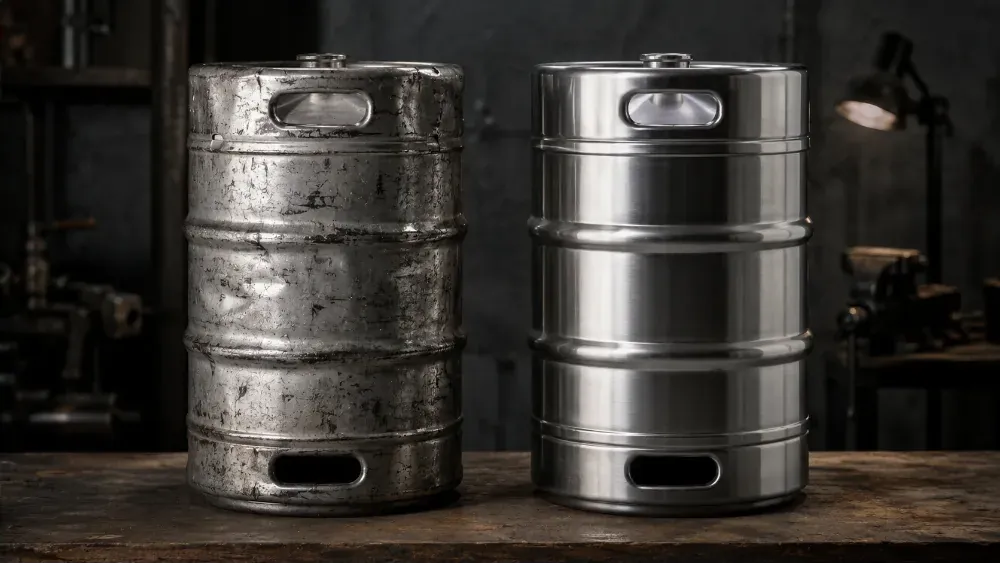
This is where most people go wrong and look at the appearance. A scratched, dull keg with an intact neck is worth considerably more than a shiny one with a bent neck. What matters is whatever upsets the washing plant – and that is the geometry, not the surface.
Markings – and who owns them
A plain keg with no brand mark is the easiest to put back into use. A keg with your own logo can be reworked – that is called rebranding, and it costs money, which comes off the price. A keg carrying another brewery’s logo is a case of its own, and that case is a legal one. More on that below as well.
Quantity and uniformity of the batch
Fifty identical kegs are worth more each than fifty different ones. That is not arbitrary: a uniform batch goes through refurbishment in a single run, a mixed one has to be pre-sorted, and every changeover of the line costs time. Sort them before you enquire – it shows up directly in the price.
What can be repaired – and what cannot
This distinction is the heart of the valuation. Almost everything that looks like serious damage can be repaired. And a few things that look harmless cannot.
repairable
- Bent top and bottom chimes – are straightened, the stacking base is restored; there are dedicated machines for this
- Bent neck – is straightened, as long as the upper dome regains its design strength afterwards
- Beerstone and deposits – are removed chemically or by ultrasound
- Worn seals, tired springs – wear parts, are replaced
- Third-party or worn markings – are removed and reapplied
- Dull, scratched surface – cosmetic, no real loss of value
- Faulty spear – is reconditioned or replaced; the keg stays
write-off
- Damaged neck thread – the joint between keg and spear is the safety-critical point
- Dented bottom – disturbs the flow and can make the down tube bottom out
- Leaking weld seam – not economical to repair
- Frost damage – the wall is stretched, and you cannot always see it
- Signs of overpressure – measurably enlarged internal dimensions, triggered burst protection
- Aluminium kegs – no longer in circulation; here recycling really is the way
Bent neck, dented bottom and bent chime are described explicitly in the Brewers Association performance guidelines, each with the reasoning of what they do inside the cleaning machine. They are not blemishes – not even when two of them can be straightened.
What is not repaired: dents in the shell. The design does not allow them to be pushed out. A keg carries on running with them, the dent stays visible.
The practical consequence: look at the neck and at the neck thread first. If both are straight and undamaged, the keg is very probably a case for refurbishment – regardless of how battered it otherwise looks.
And if a keg really does have to be withdrawn: we take it away. We handle the recycling, the keg does not have to stay standing in your yard.
The three prices there are
And why I am not putting them side by side in a graphic.
Comparison charts are doing the rounds that show scrap value, refurbishment price and new price on one scale. It looks convincing and it is misleading, because the figures come from different countries, currencies and years. So here it is as a table, with source and date on each row – and you can see for yourself which figure holds up and which does not.
| Route | Order of magnitude | Date and source | Reliability |
|---|---|---|---|
| Scrap Material value, the keg is gone afterwards | approx. €10.45 | Our own calculation: 9.5 kg empty weight of a EURO keg 30 l × €1.10 per kg of V2A stainless steel scrap, German price overview, as at March 2026 | current and German |
| Scrap, old US figure for comparison | approx. USD 24 | US brewers association, prices as at 2013 | old, foreign currency, not transferable |
| Reconditioned tested, cleaned, with warranty | shop / request | EURO keg 30 l – small quantities in the shop, larger quantities on request | no list price |
| Refurbishment only your keg stays your keg | from approx. €5.90 net per keg | publicly listed complete package from a competitor | public, but check the scope |
| Buy-back by us | Request a quotation | depends on design, condition, quantity | on request |
The interesting row is the third one. A working, reconditioned keg is worth a multiple of its material value – a good ten euros of stainless steel on one side, a vessel with a warranty and two decades of service left on the other. In between lies exactly what refurbishment achieves. Anyone scrapping their keg sells that difference to the furnace.
You can work this calculation through with your own figures: Keg condition and residual value – enter design, year of manufacture and visible defects, read off the assessment and the value range.
The third route is often overlooked: you do not have to sell at all. If your kegs are sound at the core, refurbishment is almost always the more economical decision than selling and buying new – you keep the substance and pay only for the work. There is a separate article on that.
The special case: other breweries’ kegs
If there are kegs standing in the yard carrying the logo of a brewery you have never dealt with, the question changes. It is then no longer what the kegs are worth, but who owns them.
The answer is as a rule unambiguous, and it is written in the terms and conditions of almost every brewery. One representative wording, found many times over in this or a similar form: “All returnable empties (kegs, crates, bottles etc.) remain our property despite payment of a deposit.”
The deposit is not a purchase price, it is a security. Whoever has paid it has borrowed a keg, not bought one. The American brewers association puts the same principle even more briefly: payment of the deposit transfers no ownership, the keg always remains the property of the brewery. And further, with a view to kegs delivered to scrap dealers: breweries do not sell empty kegs to private individuals, which is why such kegs have “most likely been obtained illegally”.
That is a US statement and not an interpretation of German law. The underlying construction here is the same, however, and so is the practical consequence: another brewery’s keg is neither a find nor scrap metal.
What that means for you
A reputable refurbisher will not simply buy kegs branded by others from you. Not out of pedantry, but because he is not allowed to put them back into use without having established where they came from. Anyone who takes them off you without asking is either working dishonestly or handing the risk back to you the moment it comes to light.
The right way is unspectacular: sort the kegs by brewery, write to the brewery, offer to return them. Usually the deposit is refunded; with larger quantities they arrange collection. It takes longer than a call to the scrap dealer, and it is the only route that will not bring you a letter later on.
We take this part on if you want – identifying, assigning, making contact. It is everyday business for us and usually quicker for you than researching who owns a faded brand mark yourself. Send us your details.
This section reflects the usual contractual position and the position of the trade associations. It is not legal advice. With larger stocks of unclear origin it is worth calling your own lawyer before anything leaves the yard.
Before you touch anything
Old kegs that have stood around for a long time look depressurised. They are not necessarily.
Two rules that are not negotiable
- Never assume that a keg is depressurised. Not even if it has stood outdoors for years, not even if the spear looks damaged. Residual beer and temperature changes build pressure back up – a keg that seemed empty yesterday need not be empty today.
- Release the pressure before any work on the spear, at a distance, with a long tool, and nobody stands in the line of ejection.
And one component that is regularly overlooked in valuation: on the threadless spears a retaining ring holds the spear in the neck, and it is a single-use part – once removed, a new one goes in. A reused or tampered-looking ring is not a price reduction, it is a reason to leave the keg standing until it can be worked on properly.
What you should do before you call
Ten minutes of preparation change the offer you get – because they turn an estimate into a calculation.
- Count them and separate them by designNot “about eighty kegs”, but “44 EURO 50 l, 26 DIN 30 l, 12 unclear”. The last group can stay as it is, it just has to be named.
- Measure diameter and heightA folding rule is enough. 363 mm means DIN, 395 mm means EURO, anything below that is a slim design. The height then tells you the capacity.
- Measure the spear bodyA body diameter of 74.5 mm means a flat (A-type) or combi spear (M-type), 70 mm a triangular spear (G-type). If there is no body above the neck at all, it is a EU Sankey (S-type) or a US Sankey spear (D-type).
- Photograph the neck, straight from aboveThis is the most important picture. From it a specialist can tell in two seconds whether the neck sits straight and the neck thread is undamaged – that is, whether the keg is a refurbishment case.
- Photograph markings and brand marksFaded ones too. They decide whether a keg is sold, reworked or has to be returned – three different routes with three different outcomes.
- Note anything conspicuous, do not gloss over itBulged bottoms, bent chimes, obvious frost damage. An honest inventory leads to a price that holds; a flattering one leads to renegotiation in the yard.
- Clarify accessForklift available? A yard a lorry can reach? That sounds incidental and it is not: collection costs come off the price, and anyone who can state them in advance gets a firm offer instead of an approximate one.
You can work through the same list point by point in the condition and residual value calculator. It turns your answers straight into the spread between the scrap route and a keg fit for circulation – and tells you which details we still need for a firm offer.
In brief
The scrap price is the only figure that can be worked out without expertise – and therefore the only one many people know. It is the floor of the value, not its measure.
Look at the neck and at the neck thread. If both are sound, the keg most likely has decades ahead of it, whatever it looks like. Sort them, measure them, photograph the neck. And if third-party logos are among them, separate those kegs out before you talk about prices.
What a keg is worth in the end depends on the day, on the quantity and on the design. What it is not worth, on the other hand, can be said with certainty: the material price. You only get that once you have thrown everything else away.
Newsletter
New technical articles as soon as they are ready
About once a month: new articles, new calculators, what is moving in standards and packaging law – and offers from our range.