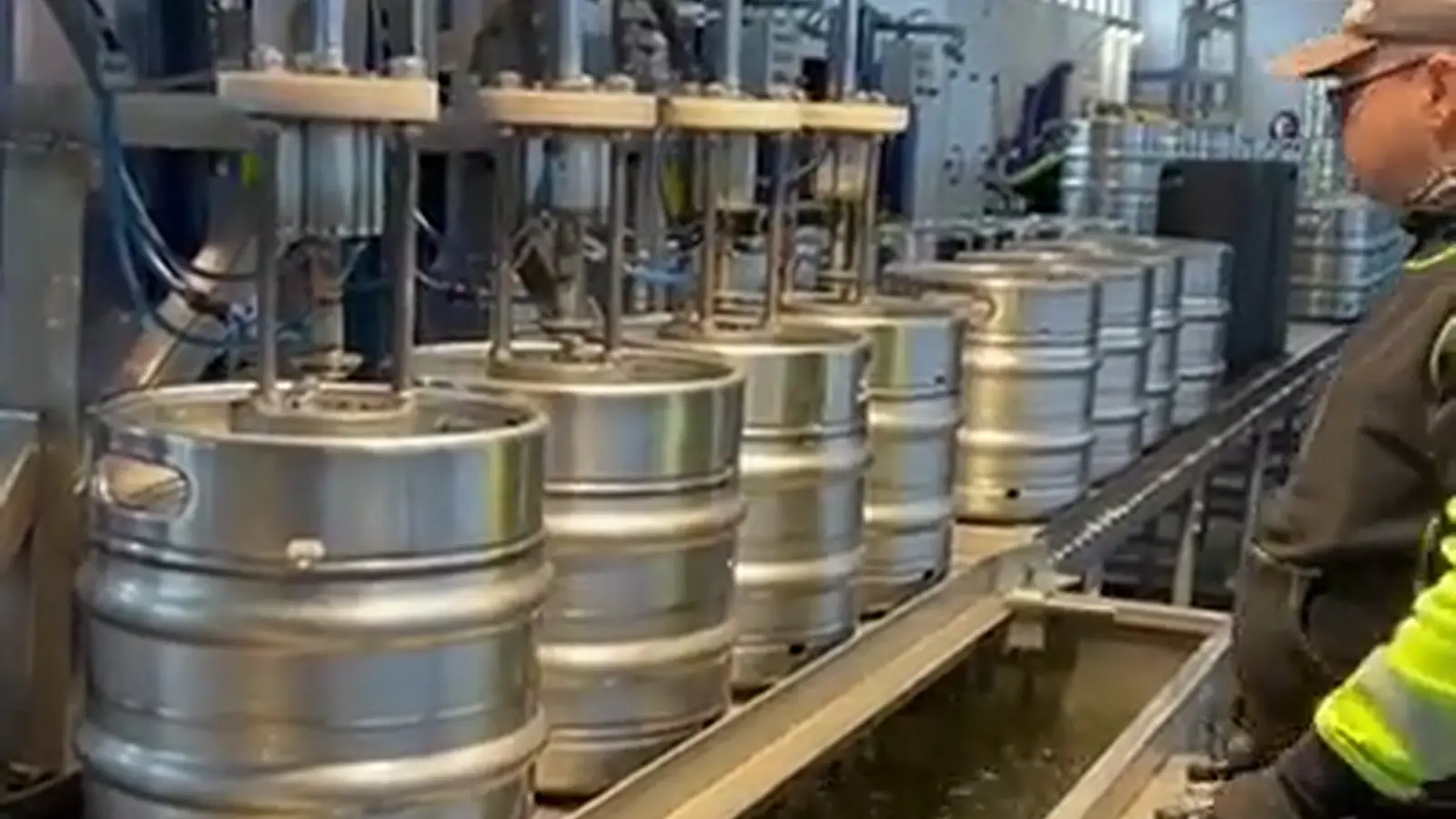
The question the keg cellar regularly gets wrong
A 50 litre keg sits at three bar. It has a proof pressure, a wall thickness and a design limit. It looks like a pressure vessel and behaves like one – and yet what applies to it is not what most people assume.
We get the question regularly, usually in one of two forms. The first: “Does our keg fleet have to be inspected every five years?” The second, rarer but more expensive: “We want to recondition kegs ourselves – do we need an approval for that?” Both questions have a clear answer, and both answers surprise.
First, so it is clear what this text is
We are a keg service, not a law firm and not an inspection body. What follows is what we read in the directives and regulations ourselves, with a source for every point. For your own operation it does not replace advice from the competent authority or your employers' liability insurance association.
The keg is outside the Pressure Equipment Directive
The European Pressure Equipment Directive 2014/68/EU governs who may place pressure equipment on the market and under what conditions. It is the reason a compressed-air receiver carries a CE mark with a four-digit notified body number.
Article 1(2) lists what is not covered. Point (r) reads:
“vessels designed for the transport and distribution of drinks having a PS·V of not more than 500 bar L and a maximum allowable pressure not exceeding 7 bar”
Do the arithmetic: 50 litres times 3 bar is 150 bar·litres. Even a keg of the higher pressure class reaches 350. No commercial keg breaks the 500 bar·litre limit – and none goes above seven bar in the first place.
That puts the beer keg outside the scope of the directive. No conformity assessment, no notified body, no CE marking as pressure equipment. Point (q) next to it additionally excludes “bottles or cans for carbonated drinks for final consumption” – the beer bottle, in other words.
What about the Simple Pressure Vessels Directive?
A fair objection, because a keg is a welded cylinder with dished ends – exactly the geometry Directive 2014/29/EU describes. It fails on a single word in Article 1: it applies to vessels containing “air or nitrogen”. Beer and carbon dioxide are not on that list.
And Directive 2010/35/EU on transportable pressure equipment? That covers pressure receptacles for dangerous goods under ADR – the CO₂ cylinder in the cellar, not the keg beside it.
The result: a beer keg is not pressure equipment in the legal sense under any of the three relevant product directives.
What applies instead: sound engineering practice
Excluded does not mean unregulated. For equipment below the thresholds, Article 4(3) of the same directive requires that it be “designed and manufactured in accordance with the sound engineering practice of a Member State”. The idea carries here too: there is a recognised state of the art, and it is written down in a standard.
For kegs that standard is DIN 6647, “Means of packaging – Cylindrical beverage containers”, in its July 2020 edition:
| Standard | Allowable operating pressure | Nominal volume |
|---|---|---|
| DIN 6647-1:2020-07 | 0.3 MPa · 3 bar | up to 50 l |
| DIN 6647-2:2020-07 | 0.7 MPa · 7 bar | up to 50 l |
The split explains why two kegs of the same shape can carry different loads. The difference is not written on the outside; it sits in wall thickness and bottom geometry. Anyone buying used kegs should know which class they are buying.
A note on honesty: both parts are paid documents, nine pages each. What we quote here is the title and scope as published in the standards publisher's catalogue. We have not read the full text, and we therefore reproduce no wall thicknesses, materials or test procedures from these standards.
Does the keg fleet have to be inspected?
The five-year question comes from the German Industrial Safety Regulation. Its Annex 2 Section 4 governs periodic inspection of pressure systems and requires, for pressure vessels, an internal inspection every five years and a strength test every ten.
The catch is in the scope. That section applies to systems made up of pressure equipment under Directive 2014/68/EU, transportable pressure equipment under 2010/35/EU, or simple pressure vessels. By the above, a keg is none of these.
A beer keg is not an installation requiring supervision. There is no statutory periodic inspection of the keg fleet by an approved inspection body, no inspection record, no inspection plate.
Where the responsibility does not disappear
The keg remains work equipment. That brings in the rest of the regulation: a risk assessment before use, safe provision, and under Section 14 an inspection whose type, scope and interval the employer sets themselves – derived from the risk assessment and carried out by a qualified person.
That is not a weaker regime, it is a different one. For an installation requiring supervision, the legislator says when to inspect. For work equipment, the operator says – and has to be able to justify why the interval is appropriate.
Anyone looking for a starting figure will not find it in German law but in the guideline of the American Brewers Association. It gives refillable kegs a life of ten to thirty years, or 60 to 180 cycles, and applies expressly to used and reconditioned kegs as well. That is a trade association figure from the United States, not a legal norm – but as a starting point for your own interval it beats nothing. How to assess the condition of an individual keg is covered separately.
How much reserve sits in the keg
The figures come from the same guideline, and they explain why the keg gets by without a statutory inspection:
| Quantity | Value | Meaning |
|---|---|---|
| Maximum allowable working pressure | 60 psig · about 4.1 bar | US industry practice |
| Recommended design pressure | at least 300 psig · about 20.7 bar | burst limit of the design |
| Safety factor | at least 5:1 | design to working pressure |
| Proof pressure at the works | 1.5 × working pressure, 30 seconds | at 22 °C |
A fivefold reserve is a lot. A keg loaded beyond its working pressure does not burst at the first extra bar – it has room. That is precisely why the practice works without official inspection.
What uses that reserve up is not pressure but force and corrosion. A dented bottom, a cracked weld, a distorted neck bush – those are the findings that take a keg out of service, not the working pressure. What of that is repairable and what is not we have written up separately.
The danger is somewhere else
Anyone looking for the hazard in a keg cellar usually looks at the wrong component. The keg has a fivefold reserve. The carbon dioxide cylinder next to it is the problem.
The German food and hospitality trade association does the arithmetic plainly: a 10 kilogram CO₂ cylinder releases about 5.1 cubic metres of gas. For that quantity to stay below three per cent by volume in the room, you need about 170 cubic metres of net room volume. For a 6 kilogram cylinder it is 102, for a 2 kilogram cylinder 34 cubic metres.
For comparison: a cellar four by five metres at 2.40 metres high holds 48 cubic metres. Gross.
The association states that a CO₂ concentration of around 10 per cent by volume in the air breathed is fatal. Carbon dioxide is heavier than air, collects at floor level, and is colourless and odourless. Anyone walking down into such a cellar does not notice in time.
The gas warning system to DIN 6653-2 therefore triggers in two stages: pre-alarm from 1.5 per cent by volume, main alarm at 3.0 per cent. Both thresholds sit far below the lethal concentration – that is exactly the point of them.
This is where the regulation turns around: there is no inspection duty for the keg, but there are requirements for the room it stands in.
Three cases from practice
“Our insurer wants proof of inspection for the keg fleet.”
That is a contractual question, not a legal one. An insurer may ask for what it likes. It should just be clear in the conversation that the official inspection being asked for does not exist for kegs – what can exist is a documented visual inspection on a self-set interval, and that can be delivered.
“We want to buy used kegs from abroad.”
With no CE obligation there is no CE mark to hold on to. What remains is the stamping on the keg: manufacturer, year of build, nominal volume and, on many makes, the allowable operating pressure. A missing or over-stamped marking is a finding in itself. What applies legally to a keg that is not yours is covered separately.
“May we have keg volumes changed?”
Yes – and because the keg is not pressure equipment in the legal sense, no conformity assessment is needed. What is needed is that the design strength is restored after the work and that this has been verified. Anyone commissioning a volume reduction should ask about welding procedure, proof pressure and leak testing, not about an approval.
The short version
| Question | Answer |
|---|---|
| Is a keg pressure equipment under 2014/68/EU? | No – expressly excluded, Article 1(2)(r) |
| Is it a simple pressure vessel under 2014/29/EU? | No – that covers air and nitrogen only |
| Does it need a CE mark as pressure equipment? | No |
| Is there a statutory five- or ten-year inspection? | No – not an installation requiring supervision |
| Is there an inspection duty nonetheless? | Yes – as work equipment; the operator sets the interval |
| Which standard describes the state of the art? | DIN 6647-1 (3 bar) and DIN 6647-2 (7 bar), edition 2020-07 |
| What is genuinely dangerous in the cellar? | The carbon dioxide, not the keg |
Our own position
That kegs carry no official inspection duty is not an oversight by the legislator but a consequence of the fivefold design reserve. It is not a free pass either. In the workshop we regularly see kegs that run for thirty years, and we see kegs that belong out of service after eight because someone threw them off a ramp.
What keeps a keg fleet safe is therefore not an interval from a regulation but the look taken at each turn: bottom, chimes, neck bush, welds. That is exactly the part an operator has to define themselves – and that no authority takes off their hands.