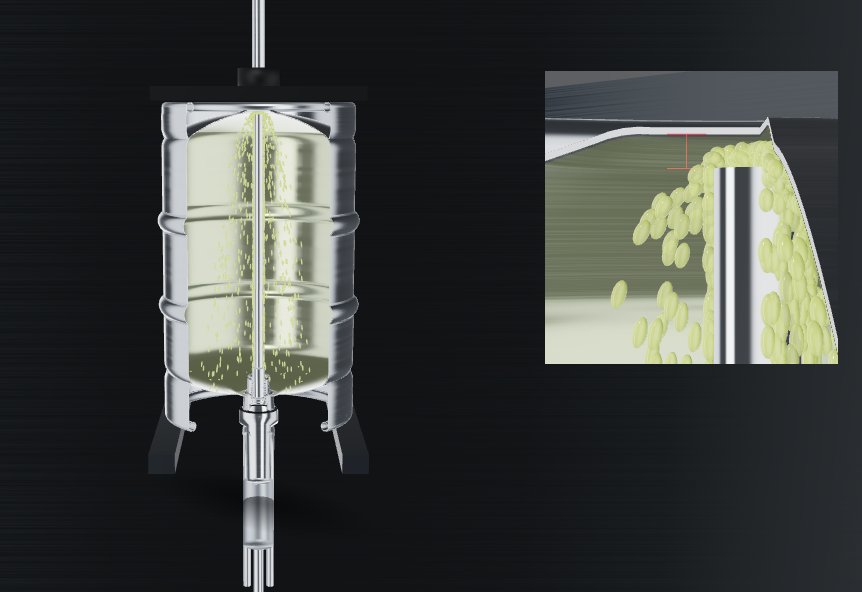
What the animation shows
During cleaning the keg stands upside down so that the cleaning medium can drain off again — the animation turns it over when you switch. The cleaning medium leaves the end of the down tube, hits the sump and is spread from there over the inner walls as a fountain. During dispensing the keg stands upright and the beer runs the opposite way through the same tube. Both processes depend on the same dimension — and they fail from the same deviation in opposite ways.
Wash shadows
The surfaces that the cleaning medium does not reach, or does not reach with enough force, are known in the trade as wash shadows. They occur not only on the keg wall but on the down tube itself — wherever the jet does not get to or has too little energy to lift the deposit. In the animation they are marked as a dashed band along the affected contour.
Both wrong lengths produce wash shadows, but for opposite reasons: with a down tube that is too long, because the gap to the sump is too narrow for the jet to spread; with one that is too short, because the jet breaks up over the long distance and falls back in the middle as a fountain.
Why this costs money
Normally only a puddle in the sump is left after dispensing. If the down tube is too short, a considerably larger quantity of beer stays in the keg — with every single container. That is a direct loss for the brewery and for the publican, and it is one of the most common reasons for complaints from hospitality to the brewery.
With a down tube that is too long, often no beer comes out at all — or only foam. Very different flow velocities then occur at the sump, and the beer foams up instead of flowing cleanly.
The bottom clearance
The bottom clearance — the gap left between the end of the down tube and the sump — is set for each valve system, and not arbitrarily. It is chosen so that the valve strokes that occur are possible at all and so that cleaning, filling and emptying run correctly.
| Valve system | Bottom clearance |
|---|---|
| A and G system — flat, three-lug | 9 mm |
| M system — combi | 15 mm |
| S system — EU Sankey (S-type) | 14 mm |
| D system — US Sankey (D-type) | 14 mm |
| U system — Guinness | 14 mm |
Why the bottom clearance is larger than it looks
During cleaning and filling the valve opens further than during dispensing. On the EU Sankey spear (S-type) that is around 4 to 6 mm on the CO₂ path and 6.5 to 8 mm on the beer path — compared with 3 and 4 mm respectively in the normal dispensing position. So the 14 mm of bottom clearance are not a safety margin picked at random, but the space the larger cleaning stroke needs.
Why 9 mm and 14 mm are so far apart
The second reason lies in the design. With the flat spear (A-type) and the triangular spear (G-type) the down tube stays where it is — coupler, cleaning head and filling head only push the valve open, the tube itself does not move. Nine millimetres are therefore enough there.
With the EU Sankey spear (S-type), the US Sankey (D-type), the combi spear (M-type) and the Guinness spear the design makes this different: on coupling, the whole down tube slides a few millimetres deeper into the keg. That travel has to stay clear at the bottom, otherwise the tube bottoms out — hence the 14 and 15 mm respectively.
It also follows that the 9 to 12 mm quoted for A and G spears cannot be a downward travel of the down tube. What is meant is the opening cross-section released, not a movement of the tube.