Inputs
The internal height determines the layers. Jumbo means a rigid truck with a trailer – hence the 38 pallet spaces instead of 33.
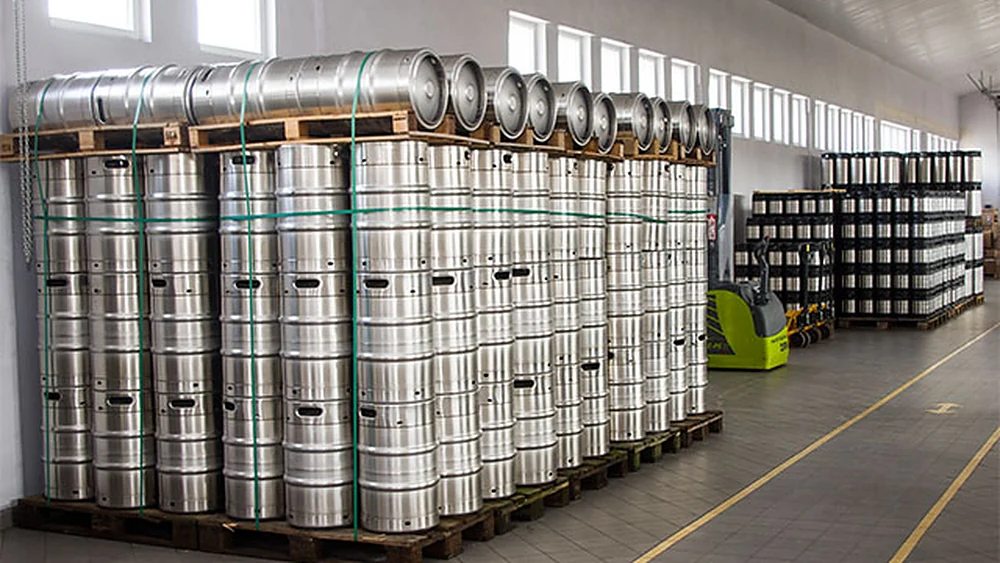
Kegs that cannot be stacked are separated by a cardboard layer pad – three millimetres per layer. An intermediate pallet costs 150 mm and 35 kg, and with that a noticeable amount of load space.
The default is what fits into the internal height.
For full kegs the capacity is counted as kilograms – beer has roughly the density of water. The cardboard layer pad then drops out: it is a matter for empties – brand-new or reconditioned kegs that go to the brewery stacked as tightly as possible.
Top view of the pallet
To scale. Grey is the pallet, yellow is a keg.
DIN or EURO – six kegs either way
On a Euro pallet measuring 1200 × 800 millimetres, at a diameter of 363 millimetres – those are the DIN kegs, the standard in German draught dispensing – three kegs fit in the long direction and two in the short one. That makes six. With the EURO kegs at 395 millimetres the picture is exactly the same: three lengthways, two across, six kegs.
The difference lies not in the number but in what is left over. With the DIN keg, 111 millimetres in length and 74 in width stay free, a visible margin all round. With the EURO keg it is 15 and 10 millimetres – the pallet is practically filled. That is all the difference amounts to. Anyone expecting a different pallet layout from those three centimetres of diameter will be disappointed; the gain lies elsewhere, namely in the height.
It becomes really clear with the slim shapes: a keg of 237 millimetres allows five lengthways and three across – so fifteen instead of six. In exchange it is taller, and that partly eats up the advantage again when stacking.
What we actually load
The calculator above returns the geometric maximum – what fits inside the internal height. In practice we often load less, because a load unit also has to stay upright. These are our usual figures from day-to-day operations – stack height in layers and the number of kegs that stands on one pallet:
| Keg type | Kegs per layer | Semi-trailer 2.70 m | Jumbo road train 3.00 m |
|---|---|---|---|
| DIN 30 l | 6 | 6 layers · 36 per pallet | 7 layers · 42 per pallet |
| EURO 30 l | 6 | 6 layers · 36 per pallet | 7 layers · 42 per pallet |
| DIN 50 l | 6 | 3 layers · 18 per pallet | 4 layers · 24 per pallet |
| EURO 50 l | 6 | 3 layers · 18 per pallet | 4 layers · 24 per pallet |
| SLIM Ø 237 mm | 15 | 3 layers · 45 per pallet | 4 layers · 60 per pallet |
With the 50-litre keg, three high is the usual palletising. That does not even come close to the 2.70 metres – on paper a fourth layer would work. We still stack it only on the jumbo, because a unit 2.55 metres high leaves no room in a standard trailer for swollen pallets and units standing askew.
On a jumbo with 38 pallet spaces that is 1,596 30s or 912 50s. Anyone running with intermediate pallets instead loses 150 millimetres of height per additional layer – with the 30s that costs a whole layer, so six kegs per pallet space and 228 on the train.
Why we calculate with 150 mm and 35 kg for the pallet
A dry Euro pallet measures 144 millimetres and weighs around 25 kilograms. Both are true only when dry. Swollen it gets taller, and wet, iced up or covered in snow it weighs considerably more. We therefore calculate throughout with 150 millimetres and 35 kilograms. That is not a standard, it is precaution: with that reserve there is no additional charge at the haulier's weighbridge.
What this calculation does not take into account
- Packaging material and layer pads. Anyone working with cardboard layer pads or hood film loses a few millimetres of height per layer.
- Overhang. The calculation allows no overhang beyond the pallet edge. Some operations run with a few centimetres of overhang and get one more row onto the pallet that way – that is an operational decision, not a question of dimensions.
- The condition of the chimes. Bent chimes mean no stacking, whatever it says here.
What goes into a semi-trailer
A standard semi-trailer takes 33 Euro pallets in one layer, with a loading area 13.6 metres long and 2.45 metres wide. The permissible payload is usually around 24 tonnes.
What a pallet space may take. Two limits apply at the same time. The pallet itself, as an EPAL Euro pallet, is designed for a load capacity of up to 1,500 kg – evenly distributed and with the pallet intact. The second limit is set by the vehicle: at around 24 tonnes of payload and 33 pallet spaces, an average of around 730 kg per pallet space remains if every space is used. So the bottleneck is almost never the pallet but the payload – 33 pallets of 800 kg each would already be over 27 tonnes and thus over what a standard train can carry.
| Quantity | Value |
|---|---|
| Pallets per semi-trailer, one layer | 33 |
| Kegs per semi-trailer at this loading | 660 |
| Load weight | 8,6 t |
| Payload utilisation | 36 % |
| Loading metres per pallet | 0.41 lm |
The practical point
Empties are almost always a volume problem, not a weight problem: a semi-trailer full of empty kegs is full long before the payload is reached. Full kegs are the other way round, almost always a weight problem – there the payload is exhausted before the load space is.
That is why returns work out differently in logistics terms than deliveries: on the way back you are carrying air. Anyone who collects empties and brings them back in full trains, instead of taking them along one by one, turns several half-empty trips into one full one.