
Why this list is different
Producing a dictionary for brewing technology is easy: you take a translation engine and feed it terms. The result is useless, because in this industry the words do not mean what the dictionary says.
That is why this list contains not a single term translated by us. Every line comes from the actual usage of three companies – Keg Exchange, Keg Rental Service and Aobaosi – in their respective language versions. Where a language is missing, that is what it says, instead of us filling it in.
The English chime is used in two different ways on our own pages: once for the neck, once in “dents in chimes and rims” for the top and bottom chime. Two different parts, one word.
A translation program would not have found the error, because both uses are defensible on their own. It only came to light when they were laid side by side.
Resolved on 4 September 2026: chime belongs to the top and bottom ring – top chime and bottom chime, in German the Stapelrand. The Muffe is called neck in English. Both have been corrected in the list below and on the remaining pages.
| Deutsch | English | Polski | Français | Español | Nederlands |
|---|
No match.
— means: in this language the term is not documented on any of the three sites. We do not enter anything there that we have not found.
Where the gaps are – and what that means
The empty fields in the table are not a blemish but the actual finding.
- French was only half there for a long time. At first a French version existed only for keg rental. The technical terms for spear, coupler, down tube, seal and safety system have since been pulled in from our spear glossary, which is checked against manufacturers’ data.
- Czech is missing altogether. Even though the Czech Republic is by far the market with the best data on spear types – and even though the EU Sankey spear (S-type) leads there by volume.
- Some terms are still missing. “Sumpf” (base cup) appears on none of our pages – although the part passes through the workshop every day.
- “Pfand” (deposit) appears nowhere. That is consistent, because our model is rental and not deposit – but customers ask about it all the same.
We publish it in this state because a list with honest gaps is more usable than a complete list with invented vocabulary. If you can fill one of the empty places because you use the term in your own operation: write to us. We will add it and note where it comes from.
Five terms that go wrong especially often
Muffe, chime, mufa
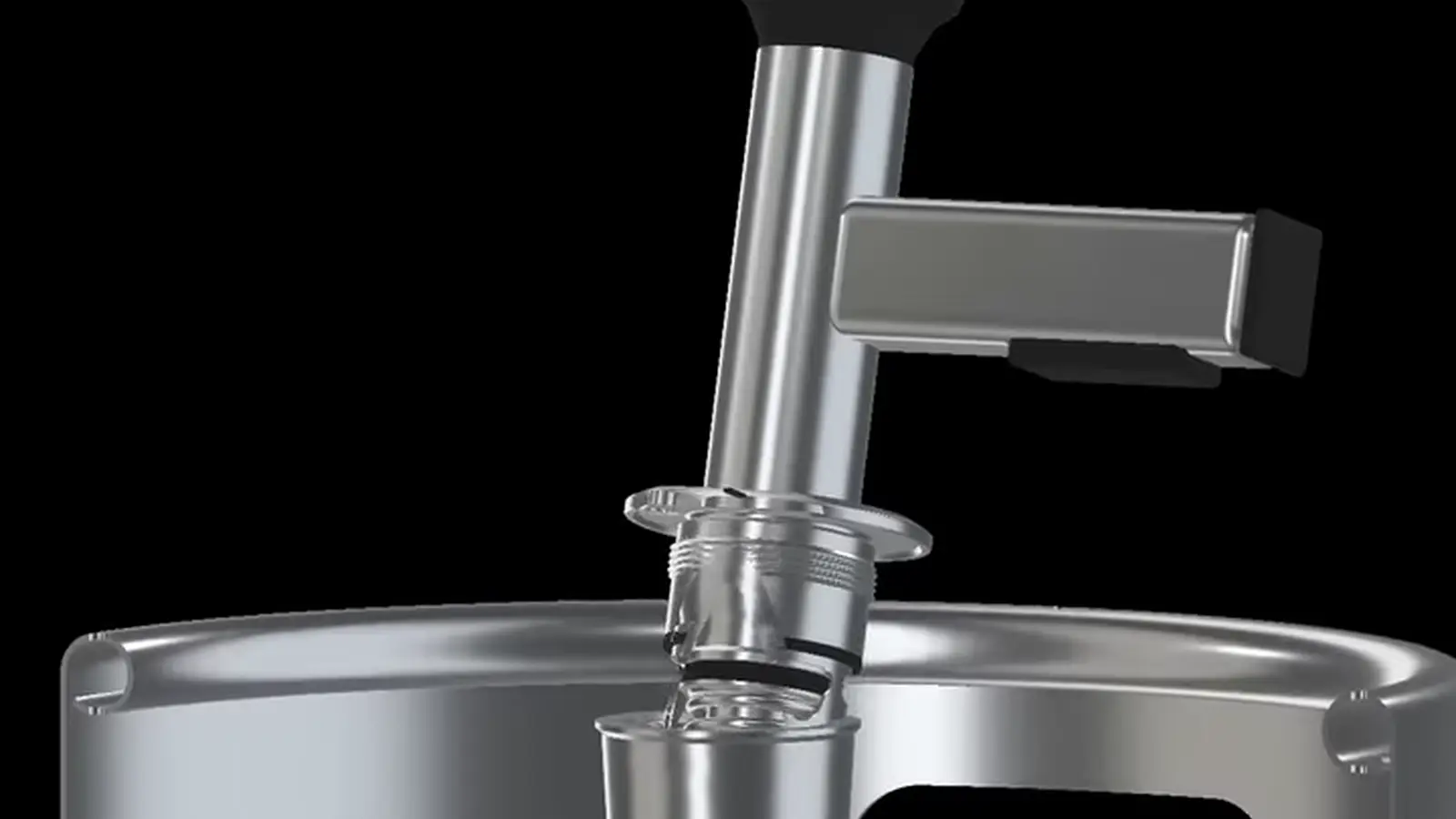
The Muffe is the threaded part in the keg neck in which the spear sits. In general usage, however, the English chime denotes the rim of a keg – that is, the stacking chime and the bottom ring. Anyone who writes “chime” and means the neck will be misunderstood.
Clearer are neck bush or keg neck for the Muffe and top chime / bottom chime for the rims.
Spear, keg spear, plongeur, espadín
In German, “Spear” is the whole part made up of valve head and tube. In English that whole part is the keg spear, the tube inside it the down tube, the valve head the keg valve; “spear” is used as well, but it is borrowed from German. In French the part is called plongeur, in Spanish espadín. Raccord means “connection” and refers to the coupling, not the part.
In an order the type should therefore always be given – A, S, D, G or M –, not just the word.
A coupler is not a spear
The coupler sits on the hose, the down tube in the keg. English keg coupler, Polish głowica, French tête de fût, Spanish cabezal de extracción. Anyone who calls both of them a “connection” will order the wrong part sooner or later.
In practice this question helps: does the part stay on the keg when the hose is pulled off? Then it is the spear.
The spear types are called something different everywhere
Flach, Korb, Kombi, Limo – English flat, Sankey (also basket), combi, soft-drink, Polish płaski, koszowy, kombi, softdrink, French à tête plate, à tête creuse, combi, soft-drink.
This is the only place in the whole group where one row is cleanly documented in five languages. It comes from an FAQ, not from a glossary – and is all the more usable for it.
Reconditioned is not the same as used
In the trade this difference decides the value. German generalüberholt, English reconditioned, Polish po remoncie or po kapitalnym remoncie, French reconditionné.
Not the same as used, używany, d'occasion – that only means the keg has already been in service. Anyone who mixes up the two words mixes up two product groups.
How this list came about
A systematic pass through all language versions of keg-exchange.com (German, English, Polish), the associated shop (the same three languages), keg-rental.de (German, English, Polish, French) and aobaosi.de (German). Only what appears there verbatim was included.
The list is being continued. If you need a line that is missing, or know one that is wrong, tell us – both are welcome, and both have happened before.
Newsletter
New specialist articles as soon as they are finished
About once a month: new articles, new calculators, what is moving in standards and packaging law – and offers from our range.