What actually happens on bottling day
Twenty litres of green beer make forty half-litre bottles. Every one of them is rinsed, sanitised, filled, capped, put away. Count honestly and you end up with one to two hours, and not a minute of it is fun.
With a keg that part disappears. What remains: clean the keg, sanitise it, rinse it, transfer. That is not nothing – a keg needs to be as clean as forty bottles – but it is one vessel instead of forty. The American brewing magazine Brew Your Own puts the difference plainly: cleaning fifty bottles is more work than cleaning one keg and its detachable parts.
Where the time saving is not
Not on brew day. That stays the same length. Not in cleaning either – a keg cleaned carelessly ruins thirty litres at once, a badly rinsed bottle only half a litre. The saving sits entirely in the filling itself, and it is largest on big batches. For five litres of trial beer the effort does not pay.
The reason that is rarely named: oxygen
Look for reasons to switch and you will almost always find time. The technically stronger reason is a different one, and it decides how the beer tastes in week six.
Oxygen that gets into the package during filling ages beer. Fresh hop aroma turns into cardboard, pale beers turn into sherry. When filling bottles, air comes in from three directions: out of the tube, out of the splashing as the beer runs in, and out of the headspace under the crown cap. Forty bottles means forty headspaces.
A keg has exactly one, and it can be cleared out beforehand. How thoroughly was measured by an Australian brewing supplier in a series of its own – the most usable figures we found on this question:
| Method | Oxygen remaining | CO₂ used |
|---|---|---|
| 1× pressurise and vent | about 138,000 ppb | about 35 g |
| 5× repeated | about 8,260 ppb | about 175 g |
| 10× repeated | about 245 ppb | about 355 g |
| Filled with sanitiser, then pushed out | about 10 to 50 ppb | about 35 g |
The last row is the point. Filling the keg to the brim with sanitiser and pushing it out with CO₂ costs roughly as much gas as a single pressure cycle and still lands a factor of a thousand lower. Pressurise and vent ten times instead and you spend ten times the CO₂ for a worse result.
What these figures are and what they are not
A supplier's measurement series, not a peer-reviewed paper. The orders of magnitude match what the brewing literature says about oxygen in the package; the absolute values depend on the meter, the temperature and the care taken. We carry them as a comparison of the methods against each other, not as absolute values for your own cellar.
Carbonation: days instead of weeks – and adjustable
In the bottle the carbonation comes from a second fermentation. You add priming sugar or gyle, cap, and wait. Two weeks is the usual rule of thumb, and at the end you find out what you got.
In the keg you set it. Chill the keg, apply the pressure from a carbonation table, wait. How long is disputed: Brew Your Own says one to two days, a German brewing guide five to seven days at constant pressure. That is not a contradiction but a question of method – leaving it at serving pressure takes longer than helping it along with higher pressure and movement.
What matters is something else: the value can be corrected. Too little carbonation means raise the pressure and wait. Too much means vent. In the bottle neither is provided for.
A worked figure
At 6 °C and 5.5 g of CO₂ per litre the saturation pressure is around 1.13 bar. Our dispense pressure calculator does the same sum, there with line length and height difference. For the cellar the carbonation table is enough; as soon as there is a hose in between, it becomes an arithmetic problem.
What the keg does worse
Four things that tend to be missing from articles about switching.
- It needs cold in one piece. A 30 l keg is about 36 cm wide and fits into no ordinary fridge. Without converting a fridge or repurposing a chest freezer you will carbonate warm and dispense lukewarm. The diameter decides, not the volume – more on that in DIN, EURO or SLIM.
- It needs a CO₂ cylinder. With a regulator, with somewhere to refill it, with a place where it can stand and be secured. That is the item that really makes the switch expensive, not the keg.
- You cannot hand anyone one. Whoever gives beer away gives away bottles. Most people who have switched therefore keep bottling a small share – with a counter-pressure filler from the keg, which works well but means equipment again.
- One mistake hits everything. An infected bottle is half a litre. An infected keg is the whole batch.
Which keg
Three designs appear in the hobby world. They differ less in volume than in the connection.
| Design | Sizes | Connection | What speaks for it |
|---|---|---|---|
| NC keg Cornelius, soda keg | 9.5 and 19 l | ball lock | Large lid, can be cleaned and inspected by hand. The standard in the hobby. |
| DIN and EURO keg | 20, 25, 30, 50 l | flat (A-type) or EU Sankey spear (S-type) | Robust, available used, compatible with trade equipment. No lid – cleaning only through the spear. |
| Junior also party keg | 5 to 20 l | flat (A-type) or EU Sankey spear (S-type) | Slim diameter, fits into some chest freezers. |
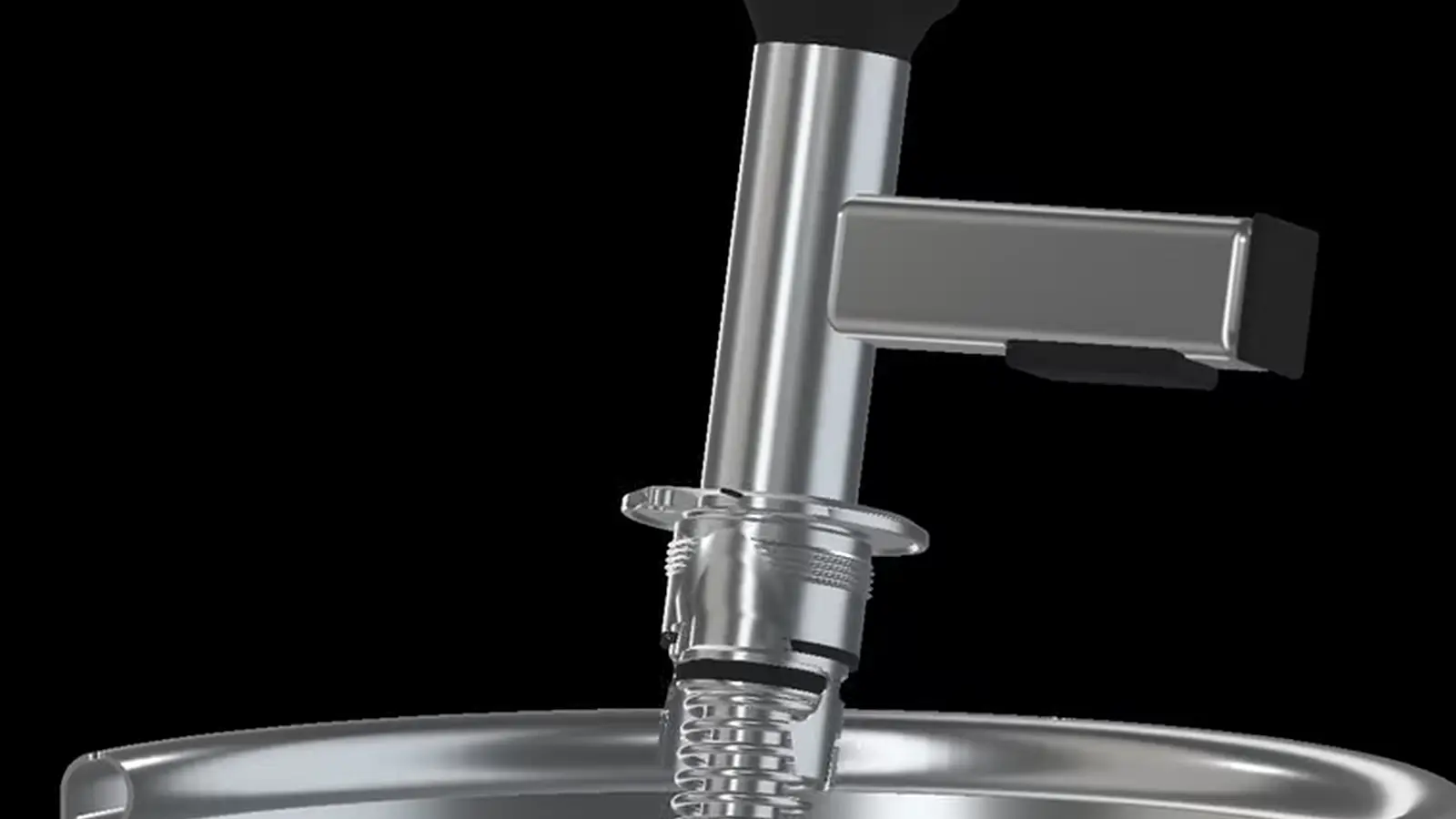
For a beginner a lot speaks for the NC keg, for one single reason: you can get inside it. A DIN keg has no opening other than the neck; you cannot see what is going on in there, and cleaning happens through the down tube. That works – breweries do it daily – but it assumes the cleaning actually reaches everywhere. What that looks like is shown in our animation of the cleaning sequence.
For the DIN or EURO keg speak the second-hand market and durability. These kegs are built for sixty to a hundred and eighty cycles across decades. Anyone buying one used should know what to look for – and which coupler fits. We have two pages on that: which coupler goes on which spear and the spear types at a glance.
Prices as an order of magnitude
A German brewing supplier quotes around €80 to €100 for a new 19 l NC keg, €60 to €80 used; a 30 l standard keg from €110 new and from €80 used. Retrieved September 2026. Those are the list prices of a single supplier, not a market survey – and they include neither CO₂ cylinder nor regulator nor coupler.
Mistake number one is foam
Read through home brewing forums and one problem turns up more often than any other: foam comes out instead of beer. Almost always it is not the beer's fault.
Foam appears when pressure is lost in the hose that the beer was holding before. Dissolved CO₂ breaks out, in front of the tap instead of in the glass. The remedies are unspectacular: a thinner or longer hose, the same temperature in keg and line, dispense pressure matched to the saturation pressure. Dispensed too cold it foams just as much as too warm, only for the opposite reason.
We built a fault-finder that works through the causes in order: foam when dispensing – finding the cause.
Pressure is not a toy
A keg is a pressure vessel, a bottle is not. That sounds like a disadvantage of the keg and is in truth its biggest safety advantage.
A beer keg carries its permissible working pressure stamped on it, and that is 3.0 to 3.5 bar – for the DIN shape as much as for the EURO shape. DIN 6647-1 gives 0.3 MPa, that is 3 bar, for this pressure class. Carbonation happens at one to two bar. So there is headroom, and above the coupler sits a relief valve.
The bottle has none of that. A filled, crown-capped beer bottle is commonly described as withstanding ten to at most forty bar at room temperature, with the crown cap intended as the weak point and meant to start leaking above about six bar. We could not verify that figure against a primary source – it comes from an encyclopaedia entry. What can be verified is the experience of every home brewer who has once primed too generously: bottles come apart, and they come apart into glass.
The one rule that must never be missing
Never put an empty keg under air pressure – neither to test for leaks nor to blow it out. The reason is in a publication of the German statutory accident insurance for raw materials and the chemical industry: at equal pressure and volume, the strain energies of a gas pressure test with air compared with a hydrostatic test with water are in a ratio of about 14,000:1. A vessel full of liquid releases little energy when it fails. A vessel full of gas is something else entirely.
Anyone buying a used keg should also know that older spears without a safety hook are still in circulation. Without that hook a spear can be shot out of a keg that still holds pressure while it is being unscrewed. Before any work on the spear, therefore: vent immediately beforehand, keep your distance, and do not stand over the keg. The whole picture is in spear with or without a safety catch.
The question that sits in every forum and never gets answered
It comes up in every larger home brewing forum and regularly stays unanswered: may I use a brewery's deposit keg for my own beer?
The answer is short and pleases nobody: no. The deposit is a security, not a purchase price. The terms and conditions of practically every brewery carry a sentence like „all returnable empties (kegs, crates, bottles etc.) remain our property despite payment of the deposit." The American brewers association puts the same principle in a formula: whoever leaves a deposit is renting – not buying.
On top of that comes § 935(1) of the German Civil Code: in an item that was stolen from its owner or otherwise lost, even a good-faith buyer acquires no ownership. The keg taken over from a neighbour, which came from a pub yard, does not become yours by being paid for.
In practice: buy kegs that are sold as property – new or refurbished, with an invoice. Anyone who already has a foreign brewery keg in the cellar will find the way back in a foreign brewery keg – what now?. We take over the return to the brewery including collection and freight; a phone call is enough.
The shopping list
What is actually needed, in the order in which it gets bought.
- A keg the size of your usual batch. Better one too small than one half full – a half-full keg is a keg with headspace.
- CO₂ cylinder with regulator. Two gauges are pleasant, one for cylinder pressure, one for working pressure.
- Connections: two ball-lock couplings for the NC keg, a coupler matching the spear for a DIN or EURO keg. Which one that is, the keg decides, not the wish.
- Hose and tap. Size length and inner diameter to the dispense pressure, otherwise see the chapter on foam.
- Cleaner and sanitiser. Clean alkaline, follow with acid, sanitise – and do it so that the medium reaches the down tube as well.
- Cooling. The item most often underestimated.
Not on the list: a counter-pressure filler. It makes sense as soon as you want to give beer away or send it to a competition – but it is the second step, not the first.
Our position on this
We trade in DIN and EURO kegs for breweries and the beverage wholesale trade, not in hobby equipment. For getting started with kegging the NC keg is the more practical choice in most cellars, and we write that down although we sell none. Our kegs get interesting where the hobby turns into a larger batch, where used trade equipment comes into it – or when a foreign brewery keg needs to go back.