Why this article
The manufacturers' glossaries are astonishingly patchy. The most extensive one we found lists a good two dozen entries – and precisely those terms that are actually asked about in the workshop are not in it.
We looked up seven of them – with the text of the standards, manufacturer documentation and what passes through our own workshop. Where a figure comes from is stated in each case.
Bierstein (beerstone)
The yellowish-brown deposit that forms in tanks, kegs and lines and that normal cleaning will not remove. English beer stone.
Chemically the core of it is calcium oxalate. The oxalate comes from the malt and is released during mashing; it reacts with the calcium in the brewing water. The resulting salt is practically insoluble in cold and in hot water alike – which is why rinsing does not help.
In practice, though, beerstone is not a pure salt. The literature describes it as a mixed deposit of oxalate, hardness salts and protein, with the protein acting as a binder. That explains why it is so stubborn: you are fighting two different classes of substance at the same time.
A beerstone deposit is rough and cracked. Micro-organisms survive in the crevices, where cleaning agents and disinfectants cannot reach them. The result is off-flavours, shortened shelf life or the loss of entire batches.
On top of that comes an effect on the product side: oxalate crystals act as nucleation sites for the carbon dioxide – one of the ways in which gushing arises. From around 20 ppm oxalate in the finished beer, haze is added to that.
It is removed with acid, not with caustic. The association's specification for keg cleaning names phosphoric acid at a concentration of 0.2 to 0.4 percent at 50 to 70 degrees, following the caustic stage. As an alternative, mixtures of phosphoric and nitric acid at around 60 degrees with 15 to 30 minutes contact time are described; the nitric acid also has a passivating effect.
Important for the sequence: if the wash stage is run too weak and the keg is then sterilised with steam, the residue bakes on. A cleaning problem then becomes a permanent one.
What does not exist: a standardised test method and a limit value for beerstone on surfaces. Testing is sensory – look at the surface and run a finger over it. Analytical methods exist only for oxalate in the beer itself.
Sicherheitsberststelle (safety burst point)
The job: a keg must not fail in an uncontrolled way under excess pressure. It should open in a defined manner at a defined point so that the pressure escapes under control.
DIN 6647-2 requires, for the higher pressure class up to 7 bar, a safety burst point that safely relieves the excess pressure at no more than 4.5 MPa – that is 45 bar. The text of the standard speaks of a burst point, not of a disc.
And that is how it looks in practice too: what we find in the running stock is the formed-in predetermined breaking or burst point – not a separate component, but a deliberately weakened zone in the sheet metal of the keg body. A patent specification from a German keg manufacturer describes it and names manufacturing tolerance as the core problem: on a burst point made as a notch, hundredths of a millimetre decide the response pressure.
A true burst disc as a component of its own is something we have not come across in our stock so far. Individual manufacturers list such a thing in their data sheets – we cannot demonstrate it on the kegs that pass through our workshop.
Response pressure
A manufacturer’s glossary gives an upper limit of no more than 4.5 MPa, that is 45 bar for the 7 bar class under DIN 6647-2. We have not seen the text of the standard; the figure stands here as a secondary source. For day-to-day work it is the wrong quantity anyway: beer kegs sit in the 3 bar class under part 1.
The figure that counts in practice is in the manufacturers’ data sheets, and it runs from 30 to 35 bar depending on the maker, each with a ± 5 bar tolerance. One manufacturer data sheet gives 35 bar ± 5; from our own running stock we know 30 bar ± 5. That is not imprecision but a decision by the maker – and the reason you look the figure up on the keg rather than quoting it from memory.
What matters in any case is the ratio: the stamped operating gauge pressure is 3.0 to 3.5 bar, the burst point opens at 30 to 35 bar – a factor of ten. The burst protection is the last fallback far above that, not a piece of operating equipment – a keg whose disc has opened has an incident behind it and belongs on the test bench, not on the filler.
Where it sits
This is the figure that helps most in day-to-day work, and it is written nowhere: the burst point normally sits at the bottom, on the dish of the keg base – not at the top on the spear, where most people look first.
On jacketed kegs it is wholly or partly hidden: on the polyurethane keg under the jacket, on kegs of rubber-steel-rubber construction beneath the rubber. That has a practical consequence: if something escapes there, you do not see it – you find it only with additional equipment, or not at all.
| Quantity | Value | Source |
|---|---|---|
| Operating overpressure on the beer keg, maximum | 3.5 bar | our own operating figure; the manufacturers emboss the value into the keg |
| Seal in the flat spear (A-type) lifts off | about 6 to 10 bar | Expert report TU Munich (6 bar observed) and our own operating figure (7 to 10 bar) |
| Test pressure at the manufacturer and during inspections | up to 10 bar | our own operating figure |
| Pressure test at the maintenance interval | up to 6 bar | publicly documented manufacturer commitment |
| Safety burst point, upper limit | 4.5 MPa = 45 bar | DIN 6647-2 |
| Response pressure in practice | 30 to 35 bar, ± 5 each | depending on the maker; manufacturer data sheet and our own operating figure |
| Design pressure of the vessel | ≥ 21 bar | US minimum requirement. Says little about practice – see below |
The vessel is not the weak point
The design pressure turns up in every association guideline and is still the least meaningful figure in the table. It describes what the vessel has to withstand. In practice it never gets that far.
On the flat spear (A-type) the seal lifts out of its seat at about 6 to 10 bar and releases the pressure. The TU Munich expert report on the summer damage case documents exactly that: at 39 degrees and more than six bar internal pressure the seal gave way, the vessel stayed intact.
That puts the real limit of the system at roughly two to three times the operating pressure – far below design pressure and burst protection. In design terms that is the right way round: a seal fails slowly and under control, a vessel would fail all at once. Anyone who takes the burst disc for the first stage of protection has the order wrong in their head.
In practice that also means: seals pushed out of their seat are a pressure finding, not a wear finding. A spear whose seal has bulged once is pre-damaged, even if it still holds – and the question to ask then is not “which seal”, but “where did the pressure come from”.
Test pressure – and the rule you must not break
A keg is tested at ten bar at the manufacturer and during inspections. What decides the matter, though, is not the figure but what the pressure is applied with.
Always pressure-test with liquid. Never pump up an empty keg with air.
The keg under test is filled with water or another medium and then put under pressure. Putting an empty keg holding only air under test pressure is life-threatening – even when nothing happens.
The reason is the stored energy. The DGUV puts the ratio like this: at the same pressure and the same volume, the stored energy of a gas pressure test with air relates to that of a liquid pressure test with water as roughly 14,000 to 1.
Water can practically not be compressed. If the vessel tears, the pressure is gone at once and the water runs out. Air is a loaded stack of springs: if the vessel tears, the whole energy discharges in an instant and pieces of sheet metal become projectiles. As little as five percent air bubbles in the test water raise the stored energy, according to the same source, to about seven hundred times – which is why air is bled off during filling.
This is not a special path taken by the beverage industry, but the general state of the art in pressure vessel construction. The rules provide for the hydrostatic pressure test as the normal case; a gas pressure test is the exception, for cases in which testing with liquid is not possible, and it then calls for protective measures of its own.
In practice that also means: anyone who wants to test a keg for leaks in their own operation does not do it with the compressor on an empty keg. A filled keg, a water bath and a good eye are the right way – and testing at test pressure belongs with the manufacturer anyway, or in a workshop equipped for it.
Beizen und Passivieren (pickling and passivation)
Two steps that are often named in one breath and regularly confused.
Beizen (pickling)
Chemical removal of the surface. Takes off contamination and embedded free iron. Used on new kegs.
Pickling takes away.
Passivieren (passivation)
Build-up of the protective chromium oxide layer that makes stainless steel corrosion-resistant in the first place. It needs around 24 hours to reach its full effect.
Passivation builds up.
Why this is necessary after welding is usually explained too briefly. The visible temper colours on a weld seam are only half the story: beneath the oxide layer lies a chromium-depleted zone. That is exactly where corrosion attacks.
Something practical follows from that: brushing and grinding are not enough. Brushing tends to polish the oxide particles into the surface rather than remove them; grinding leaves a roughened surface. Pickling, by contrast, preferentially dissolves out the damaged areas and leaves sound metal behind. The recommended approach is the combination: clean mechanically first, then pickle.
The relevant rules are American: ASTM A967 for chemical passivation, ASTM A380 for cleaning, descaling and passivation in general. The tests there are unspectacular and all the more meaningful for it – water immersion, humidity chamber, salt spray, copper sulphate, ferricyanide-nitric acid. A part passes if no etching, no pitting and no dulling occur.
A correction in passing: DIN EN 2516, which is occasionally cited, does not belong here. It governs passivation in aerospace. For beverage containers it does not apply.
Restdruck (residual pressure)
An empty keg is not pressure-free. That is the point you have to have understood before you loosen a spear.
The residual pressure is not a remnant of the dispensing gas, but the equilibrium pressure of the carbon dioxide dissolved in the beer. As long as beer or beer residues are in the keg, this pressure builds up again and again – and it rises markedly with temperature. A keg that seems harmless when cold stands under considerable pressure in the sun.
For scale: at normal carbonation and cellar temperature the equilibrium pressure is below one bar gauge. New kegs are delivered by the manufacturer with about one to two bar gauge of oil-free air or inert gas – as protection against contamination and deformation, not as an operating pressure.
In the cleaning plant, residual pressure relief is a separate, defined process step, usually the last one before the keg is released. Without it the spear can neither be opened safely nor rinsed through properly.
What does not exist: a normative value for the residual pressure in returned empties. The relevant accident prevention rule deals with residual pressure only for compressed gas cylinders, not for beverage containers. The figures that circulate on this come from forums.
Umlaufzahl (number of trips)
One term with two meanings that regularly get mixed up and lead to apparent contradictions.
- Umlaufzahl in the sense of total use: how often a keg is filled over its life. Documented range: 60 to 180 cycles.
- Umlaufgeschwindigkeit (rotation rate): how often it does so per year. From 60 to 180 cycles over 10 to 30 years, roughly two to six trips a year follow arithmetically.
For reusable packaging in general, the German Environment Agency additionally defines a minimum number of trips: the number of uses a reusable package has to reach for it to be ecologically better than the single-use alternative. That is a break-even value, not a real rotation figure – the two are often swapped in the debate.
A side finding that fits the subject of shrinkage: in export business the rotation rates are often only one to two trips a year. A keg that takes three times as long ages on by the calendar but collects a third of the fillings.
What does not exist: reliable statistics on the actual rotation frequency of German brewery kegs. What circulates are association calculation figures and individual statements.
Die Muffe (the neck)
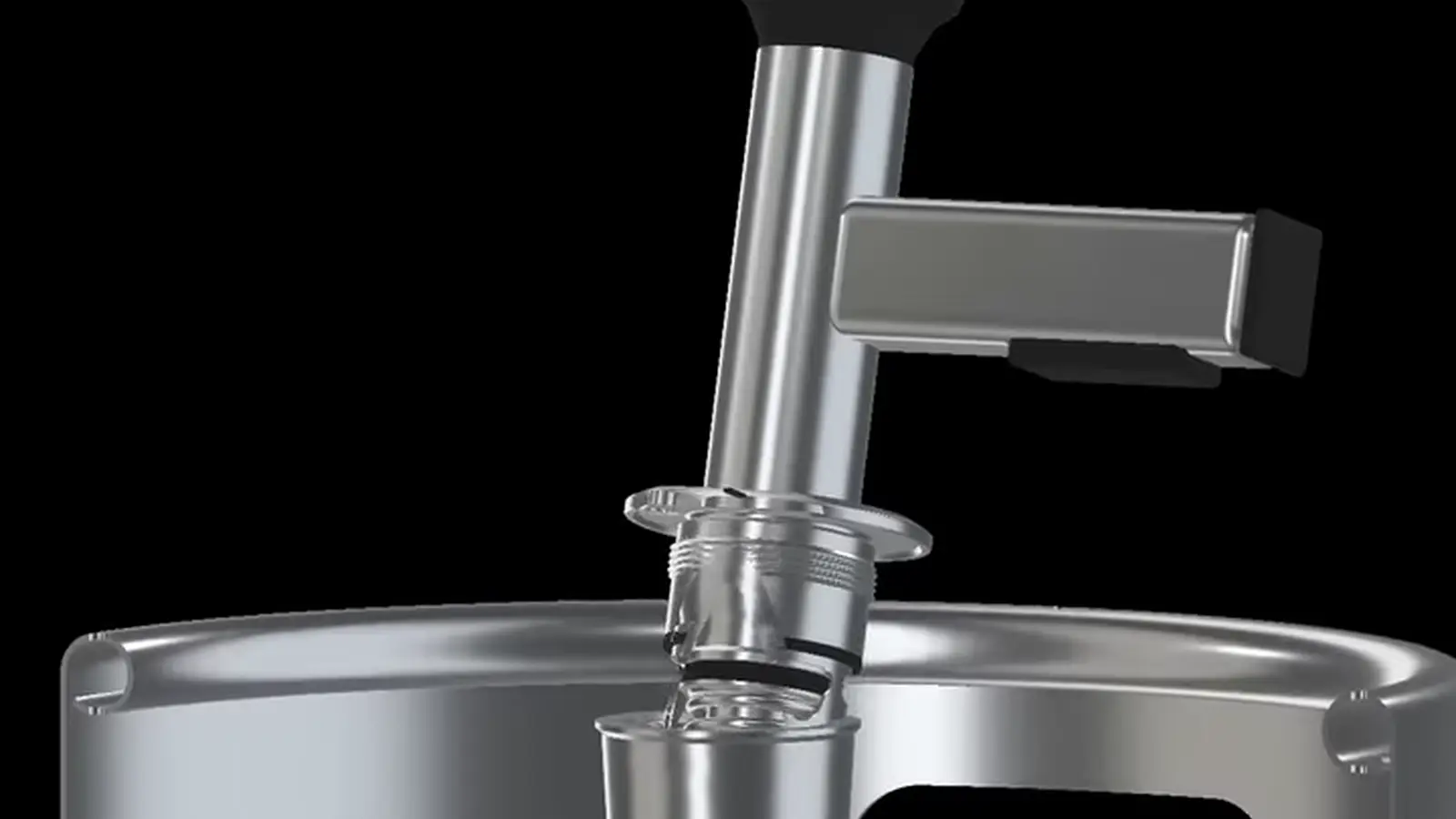
The term comes up in every conversation about kegs, and nowhere is it explained. The Muffe is the welded-in threaded part in the head of the keg into which the spear is screwed. It carries the entire operating pressure and is therefore the component on which everything hangs in safety terms.
One thread that holds almost everything together
The same thread sits in the vast majority of European kegs: 2 inches with 14 threads per inch. Because it is the same everywhere, the spear type can be swapped without working on the keg – flat (A-type), EU Sankey (S-type), combi (M-type), three-point (G-type) and US Sankey (D-type) all fit the same neck. That is why a system change is as a rule a parts swap and not a conversion.
There are two exceptions. Coarse threads – round threads in the sizes Rd 52, Rd 52.8 or Rd 53 – are found above all in kegs from the eighties and particularly often on polyurethane-jacketed types. And threadless necks, in which the spear is not screwed in but inserted and held by a retaining ring; they come mainly from the British and American markets. Neither will accept a standard spear. Anyone taking on such kegs needs the neck conversion first – and that is an intervention on the keg.
You can tell them apart without tools: the standard thread needs about ten turns until the spear is seated, a coarse thread is tight after three to five.
Why its position decides the value of the keg
The neck has to sit lower than the chime. If it stands higher, it carries load when kegs are stacked that it is not built for. And it has to sit straight: a crooked neck misdirects the cleaning jet – the keg does not get clean inside, no matter how long the plant runs – and it damages the dispensing or washing equipment when coupling.
That is why the bent neck is the most common genuine reason for scrapping at goods-in – and at the same time one that a specialist workshop can put right, as long as the dish keeps its strength. When assessing a keg, a look at the neck is therefore worth more than a look at the surface.
Waschschatten (spray shadow)
Waschschatten, Spritzschatten and Sprühschatten mean the same thing. In English it is called spray shadow or shadowed area.
What is meant is the same in each case: the area that receives no medium, or too little of it, during a jetting or spraying process because something is in the way or deflects the jet. In the keg such zones arise at the shoulder, in the transition to the chime and on the back of the down tube – and they also arise when the down tube is the wrong length. We have animated this elsewhere.
Newsletter
New technical articles as soon as they are ready
About once a month: new articles, new calculators, what is moving in standards and packaging law – and offers from our range.