The 95 percent, broken down
The most robust set of figures on the stainless steel cycle comes from an analysis by the Karlsruhe Institute of Technology of individual data from fifty countries, reference year 2019, published by the world association worldstainless. In the German version from the Informationsstelle Edelstahl Rostfrei the calculation is set out openly alongside it:
“End-of-life recycling rate (including the carbon steel cycle) … ≈ 95 %”
“Stainless steel scrap only: … ≈ 70 %”
“25 % of stainless steels are recycled at the end of their service life” – “37 % … are used to produce new carbon or special steel”
Informationsstelle Edelstahl Rostfrei, German version of “The Global Life Cycle of Stainless Steels”, KIT data 2022 for the reference year 2019So the 95 percent says: practically nothing ends up in landfill. It does not say: an old keg becomes a new keg. A considerable share of the material goes into carbon steel – structural steel, reinforcement, sections. That is recovery, but it is a step down. Chromium and nickel, which make stainless steel expensive and durable, are lost in it as alloy value.
Recycled does not mean: stays stainless steel.Around a quarter of the stainless steel taken out of service returns as stainless steel. The rest is recovered as material – mostly one class lower.
Where the material goes
The path of a stainless steel keg from manufacture to end of life – and how the material arriving there is split.
Five figures, five sources, one muddle
Search for the recycling rate of stainless steel and you find something different depending on the search term. All the values come from industry associations; an independent official counter-figure does not exist. That is not an accusation but a limitation worth knowing about.
| Figure | Origin | Reference year | Assessment |
|---|---|---|---|
| 48 % scrap 95 % end of life | worldstainless, KIT data | 2019 | The most recent value and the most transparent in method. 50 countries, analysis of individual data. |
| 85 % end of life | ISSF, “Stainless Steel and CO2” | 2021 | Expressly an estimate in its own wording: “It is estimated that at least 85 %”. Superseded by the KIT value. |
| around 60 % recycled content | SSINA, US association | 2002 | Based on production data from 2002. Still quoted today, including in Europe, where it never applied. |
| 75 to 90 % scrap | Informationsstelle Edelstahl Rostfrei | 2016 | Markedly higher than the global value. Probably describes the European electric furnace route – the source does not say so. |
| 99.8 % recovered | Eurostat, waste statistics on metals | ongoing | A different system boundary: the value describes what share of the metal scrap already collected is recovered instead of landfilled – not how much stainless steel reaches collection at the end of life in the first place. This is exactly the figure you meet most often in advertising copy. |
The sentence is correct. Stainless steel is fully recyclable – that is a material property and not a statement about what actually happens. Recyclability and recovery rate are two different things, and they are regularly treated as one.
The figure that matters is further up: of the stainless steel collected at the end of life, around a quarter comes back as stainless steel. The larger part goes into carbon steel production and loses its chromium and nickel on the way. That is the difference between a property and a rate – and the reason this article exists.
The spread between 48 and 75 to 90 percent is probably not a contradiction but a difference in system boundary: the global average is pushed down by the scrap-poor nickel pig iron route in Asia, while the European electric arc furnace runs almost exclusively on scrap. That explanation is plausible – but it appears in none of the sources. We carry it as a supposition, not as a finding.
What the scrap share does for CO2
Here it gets unusually specific. For production year 2022 the same association reports total emissions per tonne of stainless steel by scrap share, Scope 1 to 3 combined:
- 85 % scrap1.95 t
- 75 % scrap2.45 t
- 50 % scrap3.70 t
Going from 50 to 85 percent scrap almost halves the footprint. The distribution is remarkable: Scope 3 – the upstream chain, essentially the raw material – accounts for 59 to 88 % of emissions depending on the scrap share. What happens in the plant itself is the smaller part.
The recycling page of the same association states that recycling production cuts emissions “by up to 90 %”. This statement has no system boundary, no reference quantity and no evidence – and it contradicts the association's own detailed table: 1.95 against 3.70 tonnes is around 47 percent, not 90.
We name it here only so that nobody looks for it in our material. It appears in none of our texts.
Why a keg of all things is a clean recycling case
For the scrap grade “Cr-Ni scrap 18-8”, the Bundesvereinigung Deutscher Stahlrecycling- und Entsorgungsunternehmen (German federal association of steel recycling and waste management companies) lays down: chromium at least 16 percent, nickel at least 7.5 percent – and copper no more than 0.5 percent. The copper limit is the real bottleneck. Non-ferrous metal is the critical contaminant in stainless steel scrap, because it can no longer be removed once the material is melted.
This is exactly where a beer keg has an advantage that is rarely talked about: it contains no brass. The keg body is 1.4301, the metal parts of the spear are stainless steel, plus EPDM seals and little plastic. Brass sits in the coupler, not in the spear. Elastomers and plastic are uncritical because they are discharged in the shredder or burnt off during melting.
This link is our own
The copper limit comes from the BDSV, the material data from the manufacturers and from the BFBi industry specification. That a keg is therefore a particularly easy scrap case to sort is stated by neither source. But it follows cleanly from both.
The route in practice
- Inspection before scrappingA reputable recycler first sorts out what can still be reconditioned. A British operation puts this explicitly in its process description: repairable kegs are set aside, not shredded.
- DismantlingSpear out, seals and plastic parts off. Stainless steel, rubber and plastic are separated.
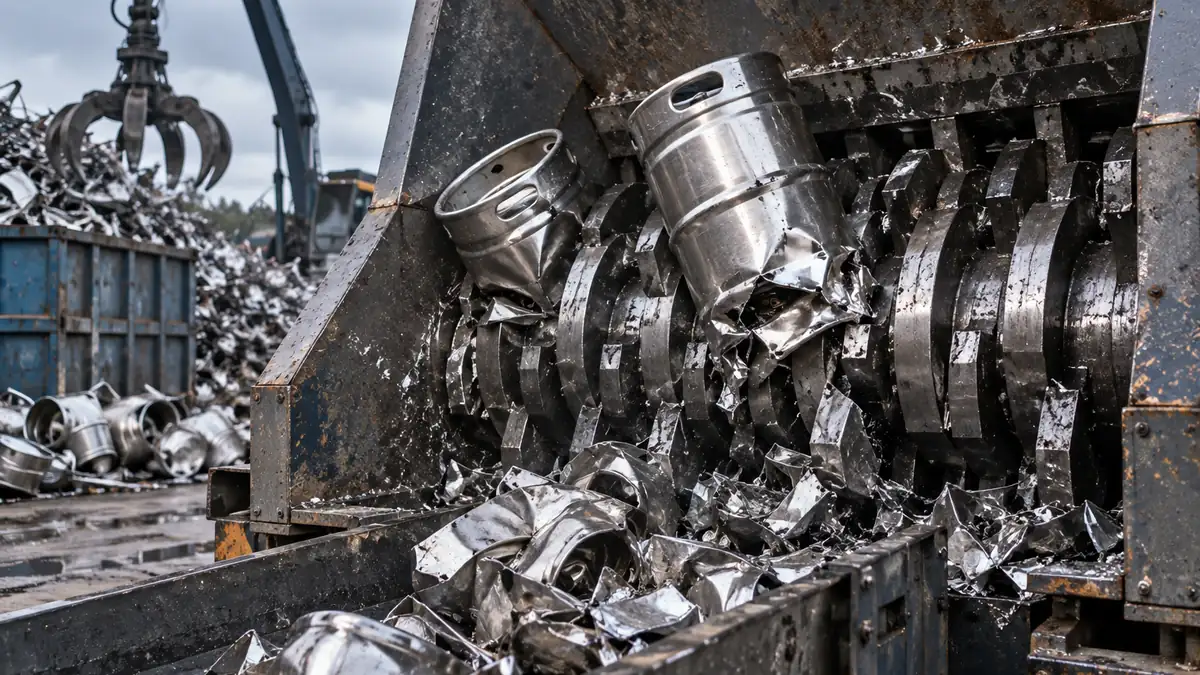
- Size reductionPress, shear or shredder – according to the BDSV the shredder is the one that separates composite materials. For polyurethane kegs that would be the obvious route; we have not verified it, no manufacturer and no recycler has published anything on it.
- SortingAustenitic 1.4301 can be separated magnetically from ferritic structural steel. The final assignment is made by X-ray fluorescence or spectral analysis.
- MeltingBack into the electric arc furnace as 18-8 scrap – or, if the sorting was not clean enough, into the carbon steel cycle. That is the difference between the 25 and the 37 percent above.
The marking decides whether a scrap dealer accepts the keg
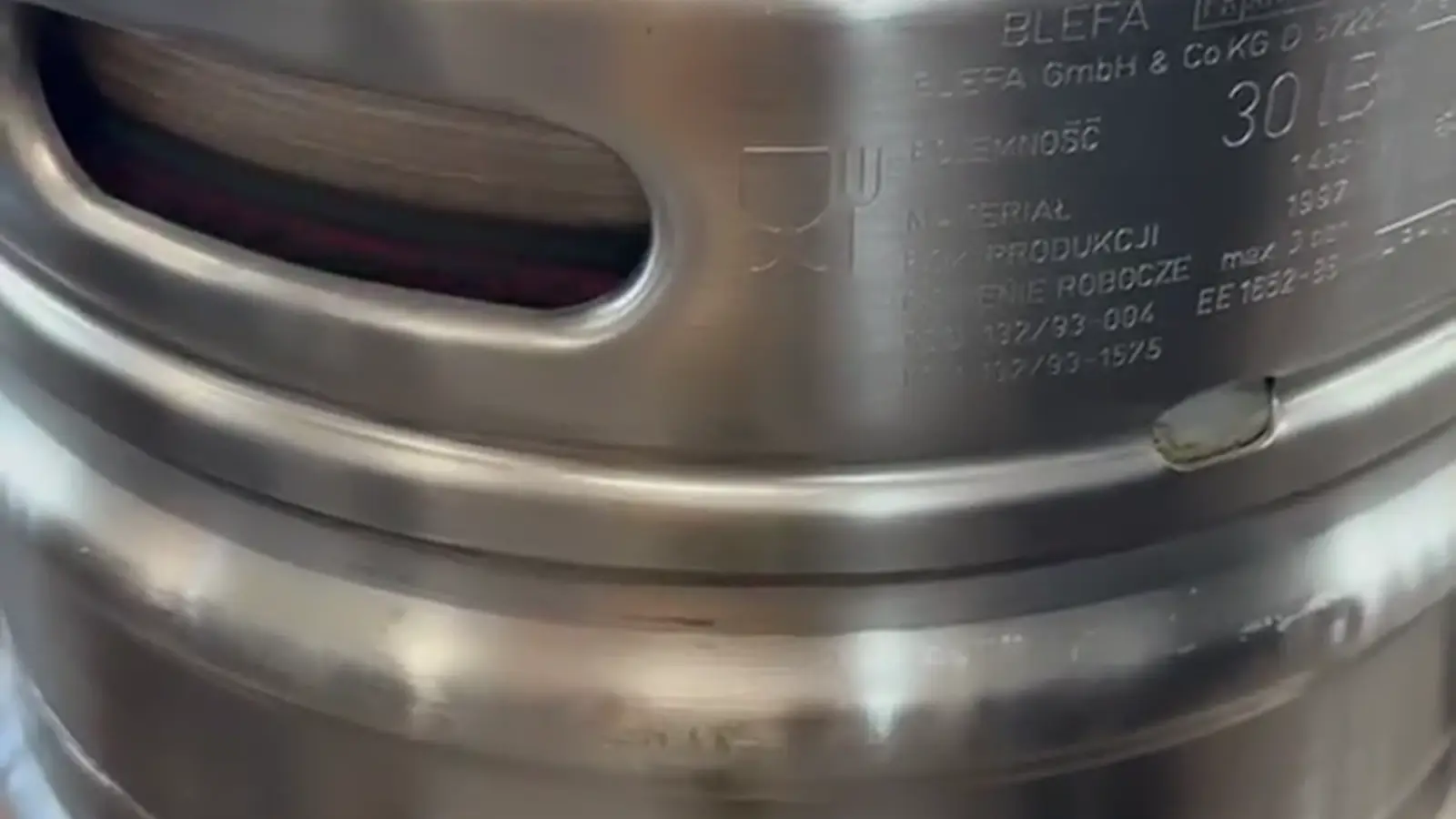
A keg with a legible marking of another brewery is the property of that brewery – regardless of who currently has it standing in their yard. Reputable scrap dealers therefore do not accept it. A keg whose marking is illegible they do not accept either, because the origin cannot then be established.
Both come to the same thing: kegs belonging to someone else do not belong in the scrap, they belong back. How that works is set out here.
What a keg is worth as scrap – and why we give no figure
There is no freely available, reliable price series for stainless steel scrap of grade 18/8. The professional European reference is the weekly assessment MB-STS-0008 from Fastmarkets, “Stainless steel scrap 18/8 solids, delivered merchant Europe”, published since July 2014. It is paid for. The same applies to the market reports from EUWID and MEPS.
What is freely available are scrap portals that average the buying offers of dealers. One of them discloses its method itself: the arithmetic mean of all prices recorded in the last thirty days from twenty-one unnamed dealers, with the note that current prices should be requested directly. That is not an index and not an assessment, but an aggregate with a business model.
It should not be confused with the alloy surcharge that the mills publish monthly. That is freely available, but it concerns new material, not scrap.
To value a keg we therefore work with dated purchase offers of our own instead of portal figures. How the valuation works in detail is set out in the workshop article.
What the PPWR says about this
Two points matter for metal packaging, and they are regularly confused.
Recycled content: does not apply
Article 7 of Regulation (EU) 2025/40 is headed “Minimum recycled content in plastic packaging”. For metal there is no recycled content quota. Three independent readings by chambers of commerce confirm this consistently.
Recyclability: very much does apply
Article 6 grades packaging by the mass share of recyclable material: grade A from 95 %, B from 80 %, C from 70 %. From 2030 at least C is required, from 2038 only A or B.
A stainless steel keg with a stainless steel spear and EPDM seals is well below five percent non-metallic mass share and reaches grade A by a wide margin. For a steel keg, Article 6 is therefore no risk. For composite containers made of several plastic layers the calculation looks different.
The same reservation applies here that we already made in the PPWR article: the official full text in the Official Journal could not be retrieved completely with our tools. The assignment of articles rests on three concurring chamber and specialist sources, not on the wording itself.
A word on our own account
We recondition kegs and we earn our money from kegs not being scrapped. The most honest sentence in this article is therefore the most uncomfortable one: a keg that goes to scrap is not an environmental harm either. It is 95 percent recovered as material. The difference between reconditioning and scrapping is not circular economy versus waste, but circular economy at a high level versus circular economy with loss of value. That is a weaker argument than “otherwise it becomes waste” – but it is the right one.
Newsletter
New technical articles as soon as they are ready
About once a month: new articles, new calculators, what is moving in standards and packaging law – and offers from our range.