
The case
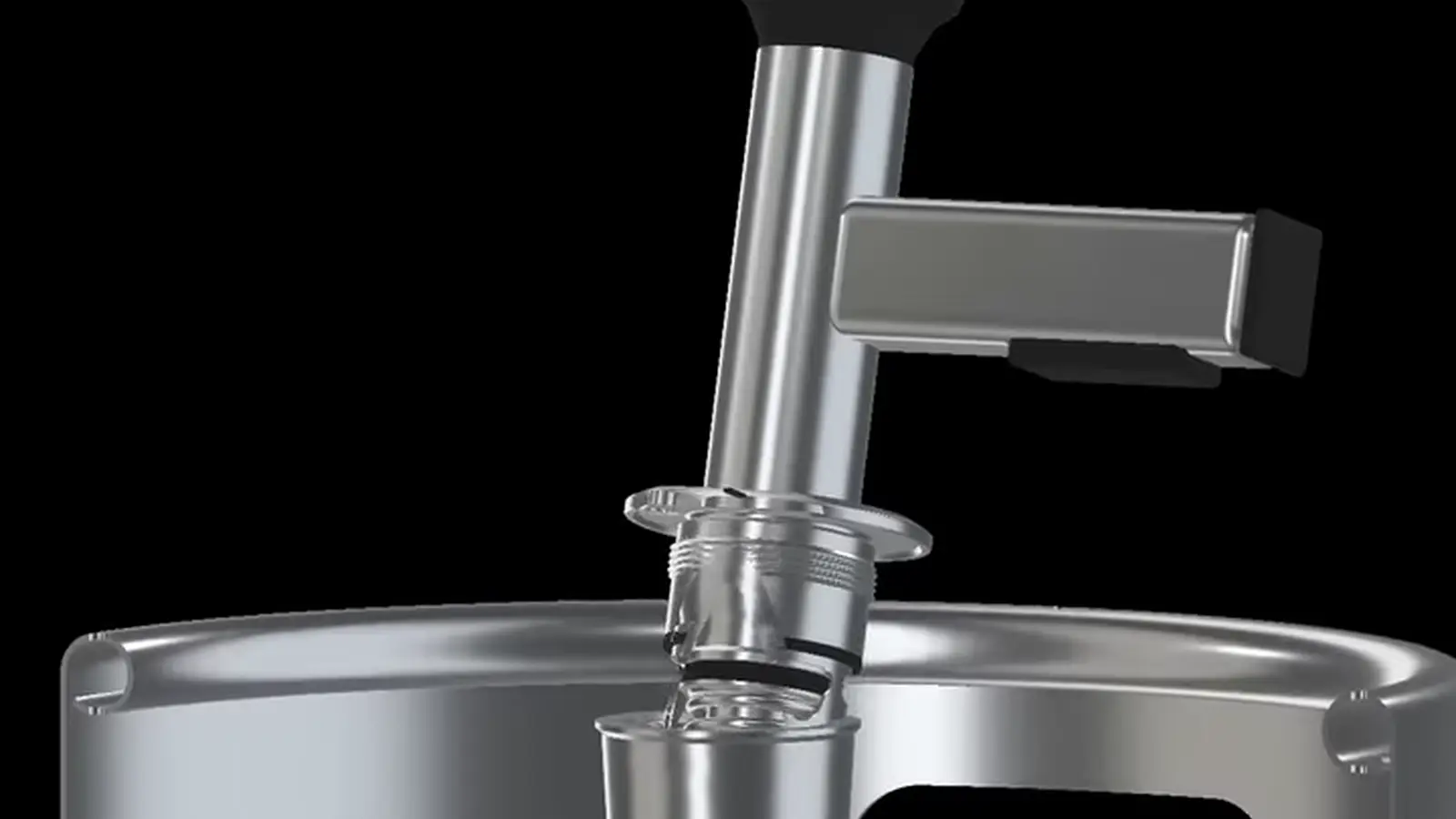
In the summer of 2017 a brewery ships a batch of 20-litre slim kegs to Italy. What comes back are complaints: the kegs are leaking. The inspection on site shows a uniform picture – almost all seals on the flat spears (A-type) of this batch had been pushed out.
Seals pushed out of place usually point to excessive pressure inside the keg. There are three known causes for that: too much carbon dioxide in the beer, incorrect filling at too high a pressure – or warming.
The brewery brings in the Weihenstephan Research Center for Brewing and Food Quality at TU München. An operations consultant comes on site.
What it was not
The most obvious suspicion is checked first – and drops out.
Three kegs from the batch concerned are examined at the research centre for their carbon dioxide content. Result: 5.15 grams per litre on average. That is in the normal range and matches what the brewery had been aiming for.
That takes the most convenient explanation off the table. It was neither too much carbon dioxide nor a filling error. The beer was fine when it left the plant.
The water bath test
So the third cause is investigated: heat. The kegs are warmed under controlled conditions in a water bath and the internal pressure is measured along with it.
At 30 °C the keg complained about is already under 3.5 bar – and thus already above the permissible working pressure of 3.0 bar. At this point the seal in the spear is already visibly bulging outwards.
At 35 °C it is pushed out. The pressure is then above 6 bar – more than twice what the keg is designed for.
The same test is then repeated with two comparison groups.
The temperature at which the seal gives way
Controlled warming in a water bath, three keg groups compared
Values as a table
| Keg group | Observation | Temperature | Pressure |
|---|---|---|---|
| 20 l slim, batch complained about | Seal bulges outwards | 30 °C | 3.5 bar |
| 20 l slim, batch complained about | Seal pushed out | 35 °C | above 6 bar |
| 20 l slim, comparison batch | Seal pushed out | 39 °C | not stated |
| 20 l standard keg | no failure, test aborted | 45 °C | not stated |
The comparison batch from another manufacturer withstood 35 °C. Only when the temperature was raised further in one-degree steps did the seal give way, at 39 °C.
And then the actual finding: ordinary 20-litre kegs from the same brewery – same capacity, same beer, but not a slim keg type – withstood 45 °C without anything happening. Nothing higher was tested, because it would no longer have had any bearing on practice.
Why the slim keg gives up first
Same capacity, same beer, ten degrees of difference. The explanation in the report is brief and it lands: the standard keg has more gas volume above the beer.
A 20-litre DIN keg measures 363 millimetres in diameter, a slim keg 237 to 278 depending on the series. Both hold the same quantity, but the wide keg is lower and has a large, flat area at the top. The headspace – the gas cushion above the beer – is considerably bigger there.
- The beer expandsWhen the keg warms up, the liquid takes up more room. For a US half barrel, around 200 ml of additional volume at 15 °C is documented against cellar temperature, 260 ml at 20 °C and 450 ml at 40 °C.
- At the same time carbon dioxide comes out of the beerWarm beer holds less CO₂ in solution. What comes out of solution goes into the headspace.
- And the headspace gets smallerMore gas, less room. The pressure does not rise linearly but accelerates – the smaller the cushion, the steeper the curve.
- On the slim keg the cushion is thinner from the outsetThat is why it reaches the critical threshold sooner. Not because it is built any worse, but because the geometry is a different one.
And this is where the fill volume comes in
The headspace is not a large reserve. For common keg sizes, around 0.4 litres at 20 litres, 0.6 at 30 and 0.8 at 50 are documented. Every millilitre that goes into the keg too much during filling is missing exactly there.
An overfilled keg is therefore not a trivial offence, it shifts the failure threshold downwards. In the case covered by the report the fill volume was not the cause – but anyone who fills a slim keg generously takes away exactly the cushion that decides the complaint in summer.
What that means for the summer
Thirty-five degrees sounds like an extreme value. In the load compartment of a truck on its way across the Alps it is not one.
The report is clear on this: such temperatures are reached quite often during transport to southern countries – above all when the distribution routes are long or the keg stands in the vehicle for a while. Reference is made to a study of physical transport conditions in beverage logistics.
What is remarkable about it is what is not there. No mention of a material defect, no mention of a faulty batch. The finding is: this keg type has too little reserve for this purpose. That is a question of selection, not of quality.
And it explains a phenomenon every keg refurbisher knows: complaints about leaking spears pile up in summer, and they come disproportionately from exports. It is rarely the spear. It is almost always the route the keg has taken.
The limit values you should know
Anyone who has the figures in their head spots the problem before it becomes a complaint.
| Quantity | Value | Basis |
|---|---|---|
| Working pressure of flat (A-type), EU Sankey (S-type) and combi spears (M-type) | up to 3 bar | Manufacturer data |
| Permissible working overpressure of the container | up to 0.3 MPa (3 bar) | DIN 6647-1 |
| … for the higher pressure class | up to 0.7 MPa (7 bar) | DIN 6647-2 |
| Coupler on the container | up to 4 bar | DIN 32677 |
| Response pressure of the burst safety device | 30 to 35 bar, ± 5 each | Manufacturer data, depending on the maker |
| Headspace by keg size | 20 l: 0,4 l · 30 l: 0,6 l · 50 l: 0,8 l | Brewers Association |
| Volume increase on warming (½ bbl against 4 °C) | 15 °C: +200 ml · 20 °C: +260 ml · 40 °C: +450 ml | Brewers Association |
Between the working pressure of the spear and the response pressure of the burst safety device there is a wide gap – and in that gap lies the range in which the seal gives way. The burst safety device protects the keg from rupturing, not the spear from leaking. It only responds long after everything else has failed.
Put differently: a keg whose seal flies out of the spear at 6 bar has behaved exactly as it should. The seal is the weakest point – and that is intended by design, because it fails in a controlled and slow way, while a container would fail all at once.
What you can do
None of this is expensive. Most of it is a question of discipline.
- Keep to the fill volume, especially with slim kegsThe headspace is the only reserve the keg has against heat. Fill it away and you shift the failure threshold downwards – and you only notice in July.
- Choose the keg type to suit the transport routeFor long routes to the south, the wide standard keg is the more robust choice. Slim kegs play out their advantages where space is tight and the route is short – in the pub, not on the motorway to Sicily.
- Limit standing times in the vehicleThe journey is not the problem, standing still is. A trailer at a service area heats up far above the outside temperature.
- Treat seals as a wear part, not as a spare partA seal that has bulged once is pre-damaged, even if it still seals. With returns from summer exports, replacing them across the board is worth more than checking them individually.
- Keep to the cleaning parametersDocumented upper limits apply to spears: steam at 135 °C for no more than 2 minutes, caustic and acid at 80 °C for no more than 10 minutes at a maximum of 3 per cent. Chlorine-based cleaners attack the seals. Anyone who goes above that produces the leak themselves – and then blames it on the summer.
- Keep an eye on the age of the rubber partsA typical damage pattern is documented: after about ten years the rubber decomposes and comes away from the metal core – accelerated by too much steam, too much chemistry and UV light. Kegs stored outdoors age faster.
- When cases pile up, do not guess – measureThat is exactly what the brewery did right in the case described. The carbon dioxide content is determined within an hour – and if it had not been measured, the filling line would still be under suspicion today.
A word on safety
The case described ended lightly: the seal gave way, the beer was ruined, nobody was hurt. That cannot be taken for granted.
A keg under pressure is not a container, it is a store of energy
For a US half barrel it is documented that the internal pressure can reach or clearly exceed 10 bar, and up to 13 bar for a sixth barrel. A spear that comes loose under that kind of pressure turns into a projectile.
Four rules that come from practice and are not negotiable:
- Always depressurise a keg first before anything is done at the spear.
- Never assume that a keg is depressurised – and never rely on the spear having a retainer in place.
- Keep your distance when depressurising and use a long tool, so that nobody stands in the ejection path.
- Residual beer and a change of temperature can put an already depressurised keg back under pressure. A keg that was depressurised yesterday is not necessarily depressurised today.
And a detail that is often passed over: the retaining ring is a single-use part. It occurs on the threadless systems, where it holds the spear in the neck. Every time such a spear is removed, a new one belongs in it – together with the O-ring or the square seal and the CO₂ valve. On the screw-in spear there is none; there the thread holds, and the retainer is an internal safety hook.
A visible retainer cannot be relied on. Whether a spear has a safety hook only shows on the removed part. On the fitted keg, at best the type designation or a laser marking on the housing gives a hint – and hooks do get cut off afterwards. That has already led to accidents. Treat every spear as if it had no retainer.
What follows from this
The case is nine years old and it is more current than ever, because the summers have not got cooler and the export routes have not got shorter.
The lesson from it is not a technical one but an organisational one: the keg type is a logistics decision, not a purchasing decision. Anyone who buys slim kegs because they take up less space in the cold store and then sends them south has combined two correct individual decisions into one wrong one.
And if a batch comes back leaking next July: measure the carbon dioxide first. If that is right, it was the route.
Newsletter
New technical articles as soon as they are ready
About once a month: new articles, new calculators, what is moving in standards and packaging law – and offers from our range.