Preliminary note
Keg Exchange trades in stainless steel kegs and refurbishes them. Every single-use keg that is sold is a keg we do not refurbish. That is a conflict of interest, and naming it does not change it.
What can be changed is the method: no figure without a source, every manufacturer’s specification marked as such, and a separate section for everything that speaks against our position. Anyone who wants to check this article will find the evidence below.
Four systems, four designs
“Single-use keg” is a collective term for containers that have little in common technically. The most important difference runs between bag systems and bagless ones: with bag-in-ball and bag-in-box the gas presses on an inner bag and never touches the beer; with single-wall PET kegs the gas sits directly above the beer.
| System | Design | Sizes | Pressure | Spear |
|---|---|---|---|---|
| KeyKeg / UniKeg OneCircle, NL | Bag-in-ball, double-wall PET, inner bag PE/alu/PA | 10 · 20 · 30 l 1.0 to 1.5 kg | Pre-pressure 2.2 ± 0.3 bar Burst pressure > 12 bar 0 to 40 °C | proprietary K coupler; UniKeg with common spears, plus an A valve since 2025 |
| Petainer Classic Petainer, UK/CZ/SE | single-wall multilayer PET, without bag | 10 to 30 l 1.1 to 1.35 kg | not published by the manufacturer | A · G · S · D |
| Petainer Hybrid | PET with rigid chimes | 15 to 30 l approx. 2.18 kg (30 l) | max. content pressure 3.1 bar Burst pressure > 7.75 bar | A · G · S · D |
| Dolium Antwerp, since 2013 | PET and HD-PE | 12.5 to 30 l | Working pressure max. 3.5 bar Pressure relief valve 4.8 ± 0.3 bar Burst pressure > 7.2 bar · 0 to 35 °C | common types |
| PolyKeg PRO Grassobbio, IT | with or without bag | 12 to 30 l 1.02 to 1.57 kg | not stated in the product sheet | A · S · G · D · M · K – the widest choice |
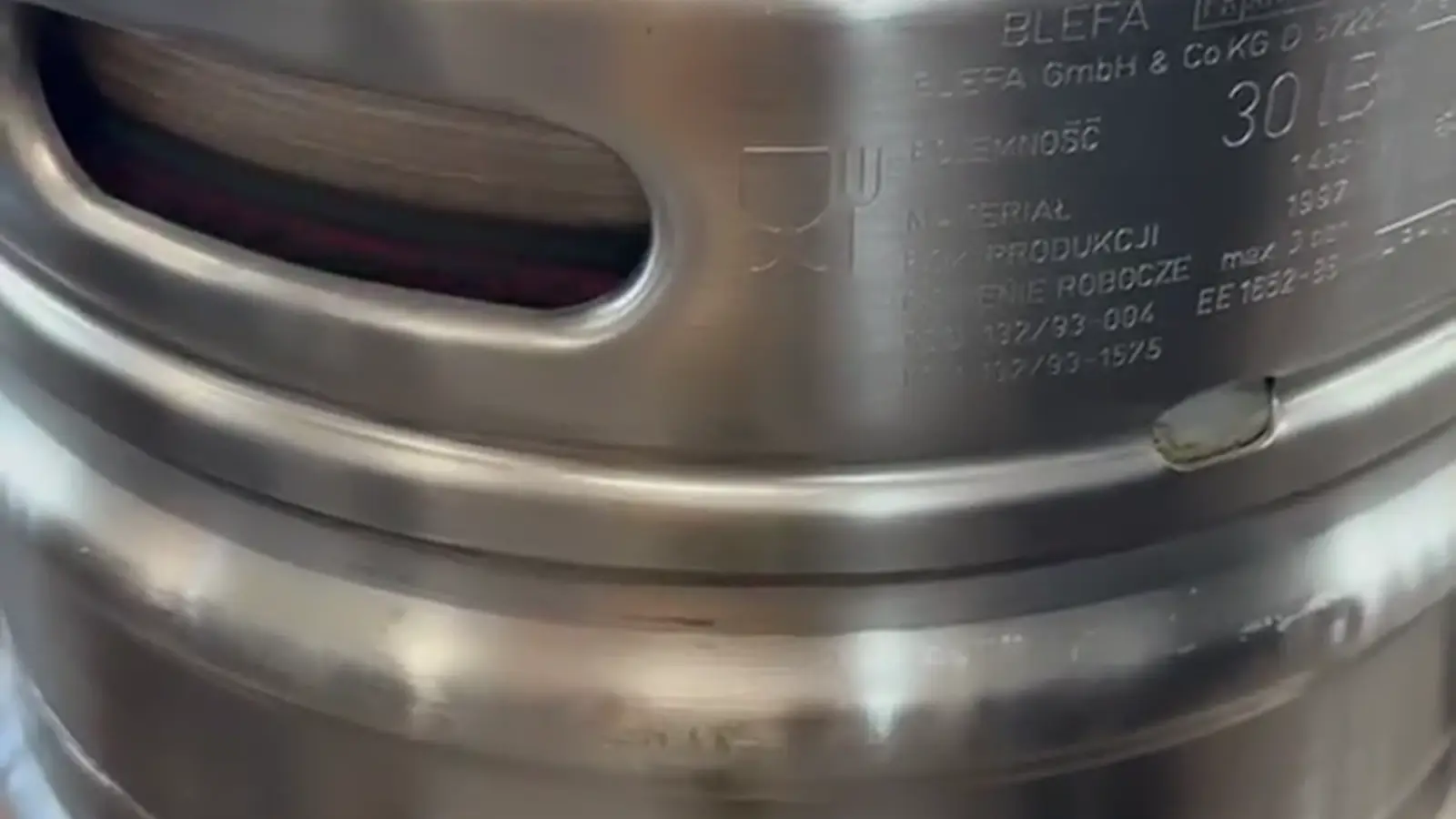
For comparison: an empty stainless steel EURO keg holding 50 litres weighs 11.8 kg. For reusable steel kegs the Brewers Association gives a maximum allowable working pressure of around 4.1 bar and a design pressure of around 20.7 bar at a safety factor of at least 5:1.
UniKeg belongs to OneCircle, not to Schäfer. Schäfer Container Systems builds stainless steel kegs. The mix-up appears in several market overviews.
Ecofass is not a single-use keg. It is a reusable container with a replaceable inner bag that works without CO2.
The state of the research: a single independent life cycle assessment
On single-use kegs versus steel kegs there is exactly one independent, peer-reviewed and freely accessible life cycle analysis: Martin, Herlaar, Jönsson and Lazarevic, published in 2022 in Circular Economy and Sustainability. It was funded by the Swedish Environmental Protection Agency and the research foundation FORMAS.
And this is the point where it gets uncomfortable for us: according to the acknowledgements, the data on the plastic kegs came from the single-use manufacturer OneCircle. The paid study in this field is not this one but the simplified assessment that a steel keg manufacturer commissioned in 2013 and which expressly does not meet ISO standards 14040 and 14044.
Where the line runs
Two thresholds from the same study. Above the distance the sign flips, below the number of uses it flips as well.
The study names its limits itself: the assumed distribution radius of 100 kilometres may be too low, the result reacts sensitively to the assumption of 80 uses, and return and recycling rates for single-use kegs are empirically unsubstantiated. Reusable plastic kegs were not included in the comparison at all, although in the authors’ assessment they could be competitive too.
The steel advantage takes effect from 38 uses onwards.That makes the exaggeration common in the industry to “more than 150 cycles” and “more than 30 years” unnecessary. It weakens an argument that would be stronger without it.
For single-use kegs themselves there is not a single life cycle assessment from a manufacturer. Not from OneCircle, not from Petainer, not from Dolium, not from PolyKeg. The emissions calculator offered by Petainer compares PET preforms with aluminium and glass, not kegs with steel kegs, and does not disclose its methodology.
What happens after use
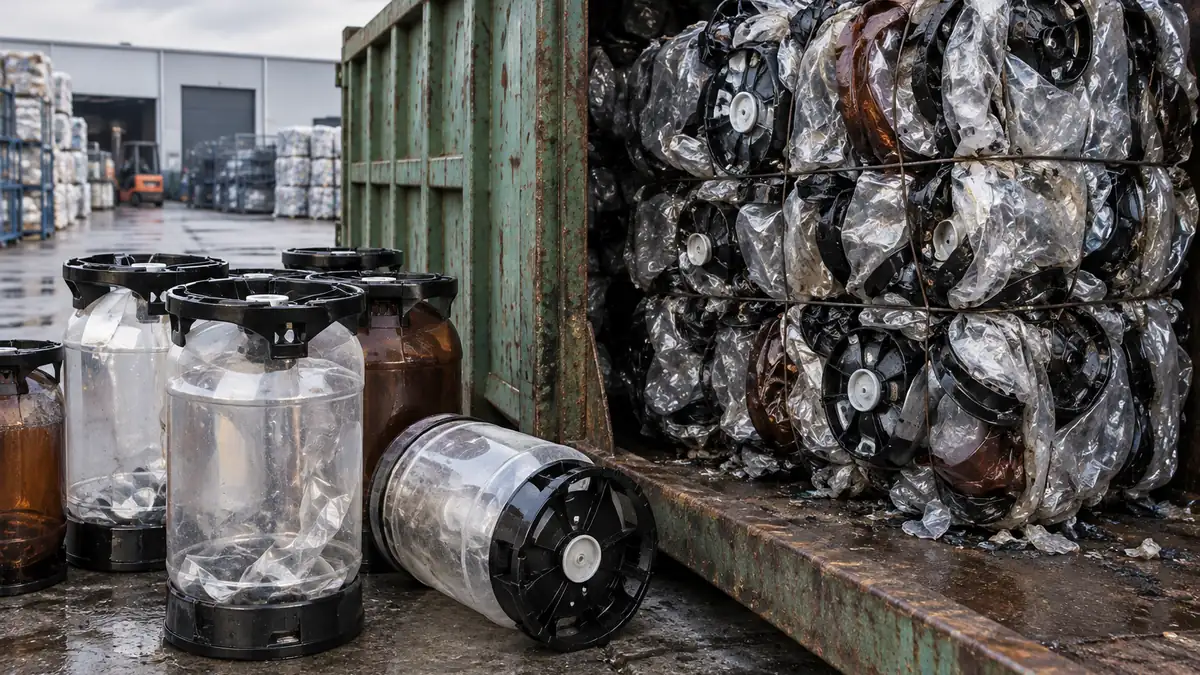
That is the question on which the whole subject turns – and the only one for which nobody supplies a figure.
It works – evidence in favour
- Norway has had a deposit system for PET beer kegs through the deposit organisation Infinitum since autumn 2021. Empty kegs are collected and picked up free of charge within five working days.
- London and northern England: collection schemes since 2018 and 2020 respectively, an estimated half a million kegs a year in London alone.
- Belgium and northern France: take-back through a waste contractor with twelve additional collection points.
- The most robust indirect evidence is the recyclate content in the new product: according to the manufacturer it rose from 30 % (2018) to 57 to 60 %. For that, material has to come back.
It does not work – evidence against
- Not a single published recycling rate – from no manufacturer, no authority, no country. Norway too reports no rate for kegs; the figure of more than 95 % quoted there applies to bottles and cans.
- The study by Martin and colleagues states verbatim that empirical evidence for recovery and recycling rates of single-use kegs is missing from the literature. Its base scenario therefore calculates with no recycling at all.
- On its disposal page the manufacturer itself speaks of a take-back network “in various countries”, “where available”, and is actively looking for new partners. It gives no rate.
- For Germany we found no take-back or collection system for single-use kegs.
The most telling voices come from practice, and they do not come from competitors.
In 2018 a London publican described in the trade press that they had “hundreds” of them, and that the recommendation was to vent them, crush them and put them in the residual waste. On the recommendation to drive them to a recycler yourself, he asks where people are supposed to take them – and who has the time for it when the trip takes thirty or forty minutes.
A London drinks supplier writes that KeyKegs are hard to recycle and, he suspects, mostly end up in landfill; responsible disposal causes additional costs at his end.
Morning Advertiser 2018 and DeskBeers, paraphrased. Both statements come from users, not from manufacturers.An American brewery has stopped using them and gives as reasons acceptance problems in the trade, actual recycling, and difficulties in dispensing. In 2017 the environmental agency of the state of Oregon concluded in an unpublished screening assessment that recycling the plastic kegs does not substantially improve their profile.
The technical differences that count in operation
- Tight is the wrong wordSingle-use kegs are not tight, they are permeable to specification. The manufacturers state oxygen uptake and CO2 loss as figures, and from those follow real deadlines: in one system the oxygen barrier runs from manufacture, not from filling. So an empty keg ages in storage too.
- Much narrower pressure and temperature windowsBurst pressures between 7.2 and over 12 bar against a design pressure of around 20.7 bar for the steel keg. Temperature limits of 35 or 40 °C where a steel keg has none. In summer export that is an issue.
- HandlingOne manufacturer expressly points out that empty containers are not wind-stable even when palletised, and unpalletised may be stacked no more than two layers high.
- Weight and logistics1.0 to 2.2 kg against 11.8 kg for the 50 l steel keg – and no return, no cleaning, no deposit management, no shrinkage. The strongest demonstrable advantage, and both independent assessments point in the same direction: distant markets and export.
- On taste we say nothingThere is no peer-reviewed sensory comparison study. A triangle test from the home-brewing scene with 28 panellists over ten days was not significant. That is no proof of equivalence, but it is enough not to make a blanket taste argument.
What the PPWR makes of it – the open question
Article 29 of Regulation (EU) 2025/40 expressly names “[…] pails, drums and canisters of any size or material […]” in its list of formats. Taken literally, a single-use keg would fall under it as well – and for domestic supply to the hospitality trade it would not be the forty per cent quota of paragraph 1 that applies but the obligation of paragraph 3, under which such packaging must be reusable within a reuse system from 1 January 2030. That would in effect be the end of the single-use keg in the German domestic market.
There is an objection to this that has to be taken seriously: a keg is primary sales packaging, and the Commission’s guidelines require a recognisable transport function. In the guidelines of June 2026 the word “keg” does not appear. There is as yet no clarification from an authority or a court.
A steel keg manufacturer writes on its website that plastic kegs cannot meet the rotation requirements of the PPWR. It cites neither an article nor a source for this. We do not adopt that argument – it would be convenient, but it is unsubstantiated.
The probably harder levers lie elsewhere. Article 6 requires from 2030 a recyclability of at least grade C (70 % of the mass), from 2038 grade A or B. A bag-in-ball keg with a composite bag of PE, aluminium and polyamide is a multi-material composite; the single-wall PET keg has the structural advantage here, and the stainless steel keg reaches grade A with ease. Article 7 prescribes minimum recyclate contents – but only for plastic packaging; metal is not affected.
The point that goes against the naive expectation
On recyclate rates the single-use keg manufacturers are, by their own account, at 57 to 60 % above every requirement the PPWR provides for up to 2040. Anyone who expected the regulation to hit the single-use keg at this point is mistaken.
For Germany one practical question remains open: single-use beverage packaging between 0.1 and 3.0 litres carries a statutory deposit – a 20 or 30 litre single-use keg is above that and is therefore deposit-free. Whether it falls under the obligation to take back transport packaging free of charge, or counts as packaging arising at an equivalent point of accrual such as the hospitality trade, is unresolved. The catalogue of the Zentrale Stelle Verpackungsregister (Germany’s central packaging register) does not list barrels and kegs. We have put the question to them.
Seven points that speak against us
- The only independent life cycle assessment is not ours. It is publicly funded and was calculated with data from the single-use manufacturer. The paid study in this field is the one commissioned by the steel keg manufacturer.
- From about 245 kilometres single-use is demonstrably better, against a closed plastic loop system from around 150.
- Norway shows that return is a question of infrastructure, not a law of nature. Where a deposit system exists, plastic kegs come back too.
- The coupler incompatibility is a problem of a single system, not of the single-use keg as such. Other suppliers deliver A, S, G, D and M.
- On recyclate rates the single-use manufacturers are ahead. 57 to 60 % exceeds everything the PPWR requires up to 2040.
- The industry exaggerates the service life – “more than 30 years”, “more than 150 cycles” – although the steel advantage takes effect at 38 uses. The exaggeration is unnecessary and makes vulnerable what stands perfectly well without it.
- The sharpest criticism of the single-use keg comes from practitioners, not from competitors. The arguments from the steel side, by contrast, often come without sources.
What remains in the end
The decision between single-use and reusable is not a matter of faith but a question of two figures: how far the beer travels, and how often the keg comes back. Under about 245 kilometres and with a functioning return, the steel keg is demonstrably ahead. For distant markets without return it is the single-use keg.
What currently makes the comparison unclean is the same on both sides: one side backs its environmental claims with not a single life cycle assessment. The other exaggerates service lives it would not even need.
Newsletter
New technical articles as soon as they are ready
About once a month: new articles, new calculators, what is moving in standards and packaging law – and offers from our range.